1
INSTRUMENT OPERATIONAL FEATURES
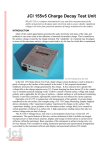
Test Area: The JCI 155 has a 45x54mm test aperture in the instrument baseplate. This can
rest directly on the test surface. Contact with the surface around the test aperture provides a
return route for outwardly migrating charge and high local capacitance to trap such charge. With
short duration corona charging (e.g.20ms) the presence and position of the outer earth boundary
is not important. Measurements can be made on surfaces smaller than the test aperture area.
Charging: The surface is charged by a high voltage corona discharge (3-10kV) from the
tips of a small conical cluster of fine wires mounted on the underside of a light moveable plate.
This plate is moved between the fieldmeter sensing aperture and the material surface exposed
through the instrument baseplate. Corona is usually generated as a brief pulse (20ms)
immediately before the plate is moved away. The plate moves fully away within 20ms.
The moving plate and instrument construction shield the fieldmeter from high voltage
connections so reliable measurements can be made down to even quite low surface voltages. An
‘air dam’ is included on the trailing edge of the moving plate. This sweeps away residual air
ionisation at the end of the corona period to give a so there is little influence on surface voltage
measurements (no more than about 10V).
Fieldmeter: A proprietary fast response 'field mill' electrostatic fieldmeter [5,6] gives fast,
sensitive and stable measurement of surface potential. The response time is below 10ms and
charge decay times can be measured from below 50ms to many days.
Fieldmeter seen through test aperture
Instrument software provides for automatic zero setting of the fieldmeter just before each
test. In very long charge decay studies arrangements are made to check the fieldmeter zero from
time to time.
It is not easy to measure decay times with signals where noise is significant in comparison to
the signals or the signal differences to be measured. This may apply for materials that dissipate
charge either so quickly that the initial peak voltage is very low, only 10-50V, or with materials
that dissipate charge very slowly, so that small differences in signal levels need to be measured
to get results within modest periods of observation. A special feature of the JCI 155v5 is that it
uses a new ‘stutter timing’ approach for decay timing. This provides an excellent way to identify
average values of a noisy signal without slowing down time response.
Sample support: Measurements are normally made both with the material freely supported
with an open backing and also resting against an earthed backing surface. These two
arrangements represent the extremes of constraints of practical application. The longer of the
two decay times is used for assessment of the suitability of the material. The JCI 166 Sample
Support provides a simple arrangement for such measurements.
Simultaneous measurement of the quantity of charge received by the sample surface and the
initial peak surface voltage achieved enables calculation of the ‘capacitance loading’ experienced
by charge on the sample surface [3,4,8]. The JCI 176 Charge Measuring Sample support
provides the ability to measure the corona charge received by the sample. This unit can be
directly connected to the JCI 155v5 (by an 8w-8w DIN cable) so that charge measurements are
stored alongside the relevant charge decay observations. Measurements using the JCI 176 can be
with both open and earthed backing.