1
On these operating instructions
!
Text
If the text follows a mark (as shown on the left), this means that an important instruction
follows.
If the text follows a mark (as shown on the left), this means that an important warning
follows relating to danger to the user or damage to the apparatus.
Italic indicated text indicates that the text concerned appears in writing on the display(or
must be typed).
Introduction
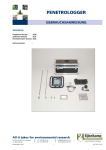
The penetrologger has been especially developed to measure the resistance to penetration of the soil and to
save the measuring results to digitally process them on a computer. The penetrologger is ergonomically
designed, lightweight and easy to use. It can be used to measure to a depth of 80 cm.
The resistance to penetration of the soil is the resistance of the soil to the force of penetration per unit area,
expressed in [N/m2 ] or in [MPa]. The resistance to penetration depends on soil properties such as bulk density,
moisture content, soil structure and –texture, organic matter content and stoniness.
The penetrologger is suitable to save and process 500 sets of measuring data, which is ideal for carrying out
large numbers of measurements. It has a built-in penetration speed control facility (rapid and jerky penetration
produces unreliable data). The penetrologger method is accurate and has a wide measuring range.
The penetrologger is used in civil engineering, soil sciences, agriculture, and the maintenance of sports fields,
parks and public gardens.
1.
Measuring the resistance to penetration
The resistance to penetration of the soil or shallow subsoil, measured by the penetrologger is a measure of
compaction or the bearing capacity of the ground. In civil engineering, a high level of resistance to penetration
can prove to be essential for the foundation of buildings or infrastructural projects. In agriculture, however, too
high a level of resistance may be problematic. Too much compaction may hinder the rootage of crops or the
supply of oxygen. Too low a level of resistance renders insufficient bearing capacity to carry the weight of
cattle or agricultural implements
1.1
Bearing capacity
In agriculture the bearing capacity is crucial in view of the soil resistivity to the weight of cattle or agricultural
implements. In farming sufficient bearing capacity is essential for cultivation and harvesting activities. In grassland management the bearing capacity is important to allow the mechanical spread of manure or fertilisers,
extending the grazing period or to avoid the loss of grazing surface by trampling.
To assess the bearing capacity, a critical limit can be set for several applications. In the case the resistance to
penetration is above this critical limit, the bearing capacity is sufficient, below that limit it the capacity is
insufficient.
Appendix 1 lists the critical limits for the bearing capacity of pastures and sports fields, as well as the
recommendations for the size of the cones to be used when measuring with the penetrologger.
3