1
CXLSN Storage heater section - Principle of operation
The storage heater section of the CXLSN heater consists of a core
of high density heat storage bricks surrounded by a carefully designed
insulating case. During the night time off-peak period elements within
the brick core heat up the bricks to a temperature level determined
by the setting you select using the input control knob.
In the morning, when the core is at its hottest, the amount of heat
being transmitted through the insulation and emitted as radiant heat
is at its greatest and the heater feels hot over most of its upper outer
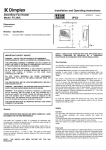
surfaces. Diagram 2.
As the day progresses, heat is transmitted from the heater to the room
and the outer surface of the heater becomes less hot and the amount of
heat released in this way becomes less.
If the amount of emitted heat becomes insufficient the output of the
heater and thus the room temperature may be increased by means
of the Output Control. This control operates a damper flap within the
heater which, when the output control knob is at minimum, covers vertical
airways which pass directly through the centre of the core of the heater.
Even when the outer surfaces of the heater are noticeably less hot, the
core of bricks can still be at a relatively high temperature. Opening the
damper flap by moving the output control away from minimum allows
the room air to circulate through this hot core and release more heat to
the room by convection. Diagram 3.
Input Control
The setting of this control determines the temperature of the room at the end of the charge period, as measured by the heater’s built-in
room temperature sensor.
With the Output Control Knob set to minimum (fully anticlockwise) for domestic use, or maximum (fully clockwise) for commercial
applications, the Input Control Knob should initially be set at the mid point position. During the day following the first charge period the
comfort level provided by the heater should be noted. If it is felt that the level of heating is either too high or too low, then the input control
knob should be adjusted up or down as appropriate before the next charge period. This process should be repeated each day until the
most acceptable conditions are attained. The Input Control knob should then be left at this setting, and the heater will automatically vary
the charge taken in during subsequent charge periods to make the most effective use of off-peak electricity to provide the selected level
of comfort at the end of each charge period.
In the Autumn and Spring a lower setting of the input control knob should be sufficient, the actual setting required being influenced by
the prevailing weather conditions, the room size and insulation levels. The most suitable settings will be found by experience.
NOTE - The input charge may be affected by other sources of heat, such as the convector. Please refer to the section ‘24 Hour
Convector Operation’ overleaf.
Output Control
Depending upon the amount of charge accepted by the heater, the OUTPUT control allows the release of additional heat by means of
a damper which can be opened to allow a greater air flow through the heater core, and therefore additional circulation of heat. By altering
the setting of the Output control knob the damper may be opened and closed manually, or it may be made to open automatically.
Manual Operation
With the OUTPUT control on minimum the damper remains closed, and heat is released from the heater only by normal radiation and
convection around the outer surfaces of the heater. This alone may provide sufficient heat on many occasions and therefore no alteration
of the OUTPUT control is necessary. However, if a boost of heat is required in the evening period, then moving the OUTPUT control
to maximum in the evening will immediately open the damper to allow more rapid release of any available stored heat. When the next
charging period commences the damper will automatically close to prevent this release of extra heat during the charge period, but the
OUTPUT control must be returned to minimum manually to obtain a similar operation the following day.