1
7.1.2
Pyrolysis of Discrete Particles
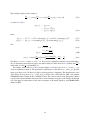
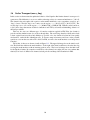
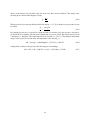
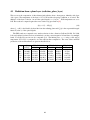
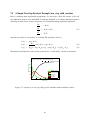
For lagrangian particles, the expected values of the mass are obtained by multiplying the material density
by the particle volume by the residue fraction. For cartesian surfaces, the particle area is two times the
product of the parameters LENGTH and WIDTH on the SURF line, both of which are given a value 0.05 m. As
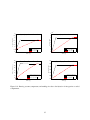
a result, the expected masses for particles with cartesian surfaces are 360(1 − 0.5) × 2δLW = 0.009 kg for
charring, and 0.018 kg for non-charring materials. Note that the half-thickness, δ = 0.01 m, is specified on
the SURF line as THICKNESS. For cylindrical particles, the LENGTH is 0.1 m, and the radius, r (specified via
THICKNESS), is 0.01 m. The expected masses are thus 360(1 − 0.5) × πr2 L = 0.00565 kg for charring, and
0.0113 kg for non-charring materials. For spherical particles, the expected mass is 360(1 − 0.5) × 4πr3 /3 =
7.54 × 10⁻⁴ kg for charring, and 1.51 × 10⁻³ kg for non-charring materials.
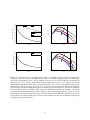
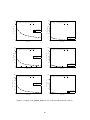
The analytical and computed results for charring material are compared in 7.3. The analytical and
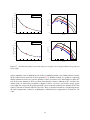
computed results for non-charring material are compared in 7.4.
57