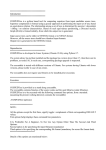
1
0
1
0
1
00000000
00000000
11111111
11111111
000000000000000000000000
000000000000000000000000
000000000000000000000000
000000000000000000000000
=0
= -0 (which = 0)
= positive infinity
= negative infinity
If you get a number with an infinite (all “1”s) exponent and anything other than an all zero fraction, it
is said to be a NAN, or “Not A Number”. NANs come in two types, signaling and non-signaling. For the
purposes of these packages, I chose a fraction with an MSB of “1” to be a signaling NAN and anything else
to be a quiet NAN.
Thus, the following classes (or states) result, wherein each floating-point number can fall:
• nan
Signaling NaN
• quiet_nan
Quiet NaN
• neg_inf
Negative infinity
• neg_normal
Negative normalized nonzero
• neg_denormal Negative denormalized
• neg_zero
-0
• pos_zero
+0
• pos_denormal
Positive denormalized
• pos_normal
Positive normalized nonzero
• pos_inf
Positive infinity
These states are used to examine and create numbers needed for floating-point operations. This
defines the type “valid_fpstate”. The constants zerofp, nanfp, qnanfp, pos_inffp, neginf_fp, neg_zerofp are
also defined.
Rounding can take four different forms:
• round_nearest
Round nearest
• round_inf
Round positive infinity
• round_neginf
Round negative infinity
• round_zero
Round zero (truncate)
“Round nearest” has the extra caveat that, if the remainder is exactly ½, you need to round so that the LSB
of the number you get is a zero. The implementation of this feature requires two compare operations, but
they can be consolidated. Round negative infinity rounds down, and round positive infinity always rounds
up. Round zero is a mix of the two and has the effect of truncation (no rounding). A type called
“round_type” is defined (in ieee.math_utility_pkg) for use on all of the rounding parameters.
Floating-point package:
In floating point there are several options that you need to choose from. Support for denormal
numbers and a large precision can take up a great deal of hardware. These may be things you can live
without. For that reason there is a version of these packages implemented with “package generics” so that
you can change the default settings.
“float_generic_pkg” can not be used directly because of the way package generics works. An instance
of “float_generic_pkg” called “float_pkg” is in the IEEE library. The data types in these packages also use
a negative index.
The package generics uses in these packages are:
• Denormalize – Boolean – Thus is used to turn on and off denormal numbers. The default is
true (allow denormal numbers)
• Round_style – round_type – This is used to specify the rounding style to be used.
“Round_nearest” is the default, and takes the most hardware. Round_zero does a truncation,
round_inf and round_neginf round up or down depending on weather the number is positive
or negative