1
Genomic Platform
Institute of research in immunology and cancer, University of Montreal
www.genomique.iric.ca
Troubleshooting Your Data
This document was taken on the Roswell Park Institute website
http://www.roswellpark.org
The two most common causes for failure to get good or any sequence data for your samples are
purity and concentration of your template DNA. If it appears that you have done everything
correctly, then look below for some additional reasons why you might obtain less than optimal
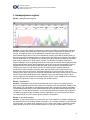
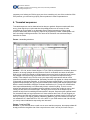
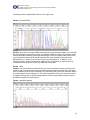
DNA sequence data quality. We’ve listed various causes, solutions and, for some, pictorial
representations of what these specific problems might look like. Many causes and solutions may
look rather obvious and just involve common sense, but you’d be surprised how many times
we’ve heard "how could I have done that?"...
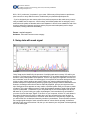
1. No sequence data
Cause: not enough or no DNA/primer in tube
Solutions: doublecheck your quantitations, stock concentrations and dilutions.. While our
sequencers are very sensitive and can detect a range of DNA concentrations, there is still a
"threshold" amount that must be reached to obtain any sequence data.
Cause: inhibitory contaminant
Solutions: the cycle sequencing reaction used to amplify samples for automated sequencing is
very sensitive to the presence of certain contaminants, some of which will completely inhibit our
sequencing enzyme. Please check the Contaminant section for a list of potential inhibitors. You
may need to reprep your sample to sufficiently remove one or more inhibitory components to
obtain any sequence data.
Cause: priming site not present
Solutions: if you’ve chosen one of the sequencing facility’s vector primers (T7+, T7-, T3, SP6,
2