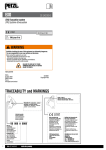
1
Only the techniques
shown in the
diagrams that
are not crossed
out and/or do not
display a skull and
crossbones symbol
are authorized.
Check our Web site
regularly to find the
latest versions of
these documents:
www.petzl.com
Contact PETZL
if you have any
doubt or difficulty
understanding these
documents.
2
1
Field of application
This equipment is personal protective equipment.
EN 1891 type A semi-static rope (low stretch
kernmantel rope).
Type A ropes are better suited than type B ropes
for use in rope access or work positioning.
This rope can be used for rope access, work
positioning and travel restraint, as well as rescue,
caving, or canyoning.
It can be used as a working rope or a safety rope.
Petzl offers different colors to help identify each
rope (working rope, safety rope, etc.).
When progressing using climbing techniques,
you must use a dynamic rope.
ATTENTION, differentiate between your EN 892
dynamic ropes, your EN 1891 type A or type B
semi-static ropes and your EN 564 cordelettes.
This product must not be loaded beyond its
strength rating, nor be used for any purpose
other than that for which it is designed.
Ropes are personal protective equipment for
ensuring the safety of personnel, do not use
them for load lifting (due to the risk of damaging
them).
WARNING
Activities involving the use of this equipment
are inherently dangerous.
You are responsible for your own actions and
decisions.
Before using this equipment, you must:
- Read and understand all instructions for use.
- Get specific training in its proper use.
- Become acquainted with its capabilities and
limitations.
- Understand and accept the risks involved.
Failure to heed any of these warnings may
result in severe injury or death.
Responsibility
WARNING, specific training in the activities
defined in the field of application is essential
before use.
This product must only be used by competent
and responsible persons, or those placed under
the direct and visual control of a competent and
responsible person.
Gaining an adequate apprenticeship in
appropriate techniques and methods of
protection is your own responsibility.
You personally assume all risks and
responsibilities for all damage, injury or death
which may occur during or following incorrect
use of our products in any manner whatsoever.
If you are not able, or not in a position to assume
this responsibility or to take this risk, do not use
this equipment.
3
You should know
Rope lifetime:
To prolong rope life (better sheath/core
cohesion), soak it in water for 24 hours prior
to first use. This removes lubricants and other
products used in manufacturing. Let the rope
dry slowly. It will shrink by approximately 5 %
(5 m for every 100 m). Take this into account
when calculating necessary lengths.
A well-used rope can shrink up to an
additional 5 %.
Avoid descending too fast on a rope as this
burns the sheath and accelerates wear. During
very rapid descents, a descender can become
hot enough to melt the nylon fibers of the
rope (230 °C).
Avoid twisting
Pack your rope in a bag without coiling it to
reduce twisting.
Marking
If you cut a rope into several lengths, you
must mark each end with the proper endmarkings. We strongly recommend marking
the new length on the rope ends. The new
lengths of rope must each be furnished with a
copy of the technical notice.
24h
ROPE
...
Copy
24h
Shock load
During a fall, a rope that is dusty, sandy, or
wet can develop a greater shock load.
The shock force increases with the amount of
wear on the rope.
History
Do not use a rope whose history you do not
know as it may have been subjected to major
falls and sustained invisible damage.
ROPE
...
Copy
2
R74 SEMI-STATIC ROPE
R745000C (190209)
Nomenclature of parts
Rope
(1) Core, (2) Sheath, (3) Heat
shrink rope end.
Optional sewn termination
(4) Stitching, (5) Thread,
(6) Protective cover.
Marking
(7) Informative sticker at
each end of the rope.
7
3
Principal materials
Nylon (rope), polyurethane
(protective cover), polyester
(stitching thread).
4-5
1
6
2