1
Caution: Federal (U.S.A.) law restricts this device to sale by or on the
order of a physician.
Device Description, Indications, Contraindications, Warnings,
Precautions and Adverse Reactions
Device Description
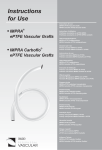
Distaflo® bypass grafts are constructed of expanded polytetrafluoroethylene
(ePTFE) with carbon impregnated into the inner portions of the graft wall. This
graft is also modified with a proprietary cuff at the distal end.
Distaflo® bypass grafts have a removable external spiral bead support over
the full length of the graft and can be used where resistance to compression
or kinking is desired.
Distaflo® bypass grafts with standard and Small Cuff have a one (1) mm
internal diameter reduction over the distal 25 cm of the graft. The Distaflo®
Mini-Cuff graft has a two (2) mm internal diameter reduction over the distal
25 cm of the graft. This reduction is intended to increase the velocity of flow
as it approaches the cuff area.
11. Exposure to solutions (e.g., alcohol, oil, aqueous solutions, etc.)
may result in loss of the graft's hydrophobic properties. Loss of
the hydrophobic barrier may result in graft wall leakage. Preclotting
of this graft is unnecessary.
12. Avoid excessive graft manipulation after exposure to blood or body
fluids. Do not forcibly inject any solution through the lumen of the
graft, or fill the graft with fluid prior to pulling it through the tunnel
as loss of the graft's hydrophobic properties may occur. Loss of
the hydrophobic barrier may result in graft wall leakage.
13. Do NOT expose Distaflo® bypass grafts to temperatures greater
than 500°F (260°C). PTFE decomposes at elevated temperatures,
producing highly toxic decomposition products.1
14. After use, this product may be a potential biohazard. Handle and
dispose of in accordance with accepted medical practice and
applicable laws and regulations.
15. During tunneling, create a tunnel that closely approximates the
outer diameter of the graft. A tunnel that is too loose may result in
delayed healing and may also lead to perigraft seroma formation.
Precautions
1.
Distaflo® bypass grafts are intended for bypass or reconstruction of
peripheral arterial blood vessels.
Only physicians qualified in vascular surgery techniques should use this
prosthesis. The healthcare provider is responsible for all appropriate
postoperative care instructions to the patient.
2.
Contraindications
The healthcare provider must observe aseptic technique during
implantation and postoperatively.
3.
When removing the external spiral support (beading) of the Distaflo®
graft, the beading must be removed slowly and at a 90° angle to the graft.
Rapid unwinding and /or removal at less than a 90° angle may result in
graft damage. Do not use surgical blades or sharp, pointed instruments to
remove the beading as this may damage the graft wall. If damage occurs,
that segment of the graft should not be used. Refer to "Anastomotic
Preparation", for further instructions. (Reference Figure 1.)
Indications for Use
None known.
Warnings
1.
All Distaflo® bypass grafts are supplied sterile and non-pyrogenic
unless the package is opened or damaged. Distaflo® bypass grafts
are sterilized by ethylene oxide.
2.
Do not use after expiration date printed on the label.
3.
This device has been designed for single use only. Reusing this
medical device bears the risk of cross-patient contamination as
medical devices – particularly those with long and small lumina,
joints, and/or crevices between components – are difficult or
impossible to clean once body fluids or tissues with potential
pyrogenic or microbial contamination have had contact with the
medical device for an indeterminable period of time. The residue
of biological material can promote the contamination of the device
with pyrogens or microorganisms which may lead to infectious
complications.
4.
Do not resterilize. After resterilization, the sterility of the product is
not guaranteed because of an indeterminable degree of potential
pyrogenic or microbial contamination which may lead to infectious
complications. Cleaning, reprocessing and/or resterilization of the
present medical device increases the probability that the device
will malfunction due to potential adverse effects on components
that are influenced by thermal and/or mechanical changes.
5.
Anastomotic or graft disruption has been associated with
Axillofemoral, Femoral Femoral, or Axillobifemoral bypass
procedures if implanted improperly. Refer to Specific Operative
Procedures (Extra-Anatomic Bypass Procedures) for further
instructions.
6.
For Extra Anatomic procedures (e.g. Axillofemoral, Femoral
Femoral, or Axillobifemoral bypass), the patient should be
cautioned that sudden, extreme or strenuous movements should
be totally avoided for a period of at least six to eight weeks to
allow for proper stabilization of the graft. Routine activities such
as raising the arms above the shoulders, reaching out in front,
extended reaching, throwing, pulling, striding or twisting should be
avoided.
7.
Distaflo® bypass grafts do not stretch (are non-elastic) in the
longitudinal direction. The correct graft length for each procedure
must be determined by considering the patient's body weight,
posture, and the range of motions across the anatomical area of
graft implantation. Failure to cut the graft to an appropriate length
may result in anastomotic or graft disruption, leading to excessive
bleeding, and loss of limb or limb function, and/or death.
8.
9.
Aggressive and/or excessive graft manipulation when tunneling,
or placement within a too tight or too small tunnel, may lead to
separation of the spiral beading and/or graft breakage. The distal
anastomosis should be made after tunneling or suture disruption
can occur. DO NOT pass the cuff portion (distal end) of the
Distaflo® bypass graft through a tunneler sheath or the tissue
tunnel, as this could lead to separation of the spiral beading and/or
graft breakage.
When embolectomy or balloon angioplasty catheters are used
within the lumen of the graft, the inflated balloon size must match
the inner diameter of the graft. Over-inflation of the balloon or use
of an inappropriately sized balloon may dilate or damage the graft.
10. Avoid repeated or excessive clamping at the same location on the
graft. If clamping is necessary, use only atraumatic or appropriate
vascular smooth jawed clamps to avoid damage to the graft wall.
Do not clamp the cuffed portion of the graft.
Figure 1
4.
Distaflo® grafts have been developed for and are especially suitable for
below the knee and infrapopliteal bypass and are not recommended for
Extra-Anatomic Bypass Applications.
5.
When suturing, avoid excessive tension on the suture line, inappropriate
suture spacing and bites, and gaps between the graft and host vessel.
Failure to follow correct suturing techniques may result in suture hole
elongation, suture pull-out, anastomotic bleeding and/or disruption.
Refer to "Suturing" for further instructions.
6.
To minimize fluid collection around the graft in Extra-Anatomic bypass
procedures or in peripheral reconstruction procedures, the lymphatics
should be carefully ligated and sealed, especially in the groin area.
7.
Consider intraoperative and postoperative patient anticoagulation
therapy for each patient as appropriate.
Adverse Reactions
Potential complications which may occur with any surgical procedure
involving a vascular prosthesis include, but are not limited to: Disruption or
tearing of the suture line, graft, and/or host vessel; suture hole bleeding; graft
redundancy; thrombosis; embolic events; occlusion or stenosis; ultrafiltration;
seroma formation; swelling of the implanted limb; formation of hematomas or
pseudoaneurysm; infection; skin erosion; aneurysm/dilation; blood leakage;
and hemorrhage.
DIRECTIONS FOR USE
Equipment Required
Tunneler, double armed sutures, atraumatic clamps, scalpels and/or scissors.
Opening the Package
Hold the outer tray in one hand. Peel back the lid. Remove the inner tray.
Peel back the inner tray lid slowly and carefully remove the graft using sterile
atraumatic instruments or gloves. Protect the graft against damage from
sharp or heavy instruments.
General Operative Techniques
Sizing
DO NOT MODIFY THE Distaflo® CUFF.
Distaflo® grafts are available in standard, Small and Mini-Cuff configurations.
The Small Cuff configuration should be used in recipient vessels with
diameters of 4mm or smaller, only, and the Mini-Cuff configuration should be
used in recipient vessels with diameters of 3 mm or smaller only.
(1)
ENGLISH
INSTRUCTIONS FOR USE