1
LUBRICATION
INSPECTION
All moving joints require lubrication on a regular maintance
schedule. Remove handle and grease the lower end of handle
where it rotates in the handle socket. Using a grease gun, lubricate the lift arm pivot shaft grease fitting until grease appears at
the end of the shaft. Grease all lift arm linkages, front wheels and
rear casters.
Visual inspection should be made before each use of the
jack, checking for leaking hydraulic fluid and damaged,
loose or missing parts. Each jack must be inspected by a
manufacturer’s repair facility immediately, if subjected to
an abnormal load or shock. Any jack which appears to be
damaged in any way, found to be badly worn, or operates abnormally MUST BE REMOVED FROM SERVICE
until necessary repairs are made by a manufacturer’s
authorized repair facility. It is recommended that an annual
inspection of the jack be made by a manufacturer’s authorized repair facility and that any defective parts, decals or
warning labels be replaced with manufacturer’s specified
parts.
A list of authorized repair facilities is available from the
manufacturer.
OWNER/USER
The owner and/or user must have a thorough understanding of the manufacturer’s operating instructions and
warnings before using this jack. Personnel involved in the
use and operation of equipment shall be careful, competent, trained, and qualified in the safe operation of the
equipment and its proper use when servicing motor vehicles
and their components. Warning information should be emphasized and understood. If the operator is not fluent in English, the
manufacturer’s instructions and warning shall be read to and
discussed with the operator in the operator’s native language
by the purchaser/owner, making sure that the operator comprehends its contents.
OPERATING INSTRUCTIONS
IMPORTANT: Before attempting to raise a vehicle, check
vehicle service manual for recommended lifting surfaces.
Owner and/or user must study and maintain for future reference
the manufacturers’ instructions. Owner and/or user is responsible for keeping all warning labels and instruction manuals legible and intact. Replacement labels and literature are available
from the manufacturer
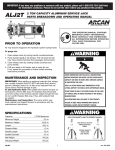
1. To raise load: Close release valve tightly (by turning
handle clockwise). DO NOT OVERTIGHTEN. Position
jack under load so that saddle will contact load firmly
and load is centered so it cannot slip. Operate jack
handle until saddle approaches the load. Once again
check to see that saddle is correctly positioned. Raise
load to desired height. Place jack stands of appropriate
capacity under the vehicle. DO NOT CRAWL UNDER
VEHICLE WHILE LIFTING VEHICLE OR PLACING
OR REMOVING JACK STANDS! Place jack stands
at vehicle manufacturer's recommended lift areas that
provide stable support for the raised vehicle.
2. To lower load: Open release valve VERY SLOWLY (by
turning handle counterclockwise). When release valve
is opened, saddle and load will be lowered. Lower the
vehicle slowly so as not to shock load the jack stands.
Once repairs are completed, raise vehicle enough to
remove jack stands. Lower vehicle very slowly.
CAUTION: Keep hands or feet away from the hinge
mechanism of the jack.
MAINTENANCE
IMPORTANT: When adding or replacing hydraulic fluid,
always use a quality hydraulic fluid. DO NOT use brake
fluid, alcohol, glycerine, detergent motor oil, or dirty oil as
improper fluid can cause serious internal damage to jack.
To add hydraulic fluid: With saddle fully lowered and jack on level
ground, remove breather. The hydraulic fluid should just cover
the surface of the internal cylinder visible through the hole. Do not
overfill. Replace breather. If low, add hydraulic fluid as needed.
Maintenance and Inspection: The owner and/or user must
maintain and inspect the jack in accordance with the manufacturer’s instructions.
66035
rev. 12/10/05