1
SAFETY 1
1.1
1
OPERATING SAFETY_______________________________________________________________________
SAFETY
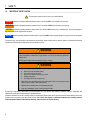
! WARNING
EQUIPMENT OPERATED IMPROPERLY OR BY UNTRAINED PERSONNEL CAN BE DANGEROUS.
Familiarize yourself with the location and proper use of all controls. Inexperienced operators should receive instruction from someone familiar
with the equipment before being allowed to operate the machine.
1.
Safety is dependent upon the awareness, concern, and prudence of
those who operate or service the equipment. Never allow minors to
operate any equipment.
2.
It is your responsibility to read this manual, and all publications
associated with this equipment (Safety & Operation Manual,
Engine Manual, accessories, and attachments). If the operator
cannot read English it is the owner’s responsibility to explain the
material contained in this manual to them.
3.
4.
5.
6.
Learn the proper use of the machine, the location, and purpose of
all the controls and gauges before you operate the equipment.
Working with unfamiliar equipment can lead to accidents.
Never allow anyone to operate or service the machine or its
attachments without proper training and instructions, or while under
the influence of alcohol or drugs.
Wear all the necessary protective clothing and personal safety
devices to protect your head, eyes, ears, hands, and feet. Operate
the machine only in daylight or in good artificial light.
Evaluate the terrain to determine what accessories and
attachments are needed to properly and safely perform the job.
Only use accessories and attachments approved by Cushman.
7.
Stay alert for holes in the terrain and other hidden hazards.
8.
Inspect the area where the equipment will be used. Pick up all the
debris you can find before operating. Beware of overhead
obstructions (low tree limbs, electrical wires, etc.) and also
underground obstacles (sprinklers, pipes, tree roots, etc.) Enter a
new area cautiously. Stay alert for hidden hazards.
9.
Never allow anyone near the machine while in operation. The
owner/operator can prevent and is responsible for injuries inflicted
to themselves, to bystanders and damage to property.
10. Do not carry passengers. Keep bystanders and pets a safe
distance away.
16. Keep the engine clean. Allow the engine to cool before storing and
always remove the ignition key.
17. Place transmission in neutral, depress clutch and engage parking
brake before starting the engine (motor). Start the engine only
when sitting in operator’s seat, never while standing beside the
unit.
18. Equipment must comply with the latest federal, state, and local
requirements when driven or transported on public roads. Watch
out for traffic when crossing or operating on or near roads.
19. Local regulations may restrict the age of the operator.
20. Operate the machine up and down the face of the slopes
(vertically), not across the face (horizontally).
21. To prevent tipping or loss of control, do not start or stop suddenly
on slopes. Reduce speed when making sharp turns. Use caution
when changing directions.
22. Always use the seat belt when operating vehicles equipped with a
ROPS.
Never use a seat belt when operating vehicle without a ROPS.
23. Keep legs, arms and body inside the seating compartment while
the vehicle is in motion.
24. Always shift transmission to Neutral (Manual Transmission) or Park
(Automatic Transmission) and engage parking brake before leaving
the vehicle.
25. Charge batteries in an open well ventilated area, away from spark
and flames. Unplug charger before connecting and disconnecting
from battery. Wear protective clothing and use insulated tools.
26. Disconnect the battery cables before performing any welding
operations on this vehicle.
11. Never operate equipment that is not in perfect working order or is
without decals, guards, shields, or other protective devices
securely fastened in place.
12. Never disconnect or bypass any switch.
13. Do not change the engine governor setting or overspeed the
engine.
14. Carbon monoxide in the exhaust fumes can be fatal when inhaled.
Never operate the engine without proper ventilation or in an
enclosed area.
15. Fuel is highly flammable, handle with care.
3