1
Introduction
1. Introduction
1.1. Methodology of urine test
The urinalysis is part of the medical diagnosis methods frequently used by medical doctors in
laboratories in order to reveal diseases.
The most cost-effective device used to screen urine is a reagent test strip.
This microchemistry system has been available for many years and allows qualitative or semiquantitative analysis within one minute by simple but careful observation. The colour change
occurring on each test pad of the strip is compared to a colour chart to obtain the result. However, misreading or misinterpreting of results, caused by individual handling habits of the user or
different light conditions, may happen.
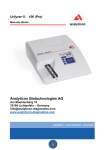
Urine analyzer (urine strip reader) equipment is designed specifically to improve the accuracy
and security of urine strip evaluation by using light and photometric reader in order to detect
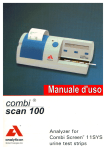
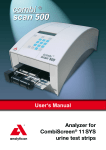
colour changes on the test strips. The CombiScan® 100 supports test data management and
report generation by offering data storage and computerized data processing features.
The CombiScan® 100 is using modern CCD-technology to analyse the colour and intensity of
the light reflected from the test pad surface, and it reports the results in clinically meaningful
units. No further calculation is needed by the user. When a strip is moved into the measuring
position under the optical unit, the reflectance of each test pad is measured. The light reflected
at specific wavelengths from the test pad depends upon the degree of colour change of the pad,
which is related to the concentration of the particular parameter in urine. The intelligent image
analyzer software reads the reagent areas and the values are calculated automatically. Results
are stored, then printed out by the built-in printer and can optionally be sent to host computer
via serial connection.
1.2. Test strip
The base of the urine analysis is the good quality dry reagent urine test strip. These strips
have separated test pads for each analyte. The test pads contain reagents, which cause colour
changes according to the analyte concentration in the urine.
2