1
SAFETY
2
2.1
2
SAFETY
OPERATING SAFETY ______________________________________________________
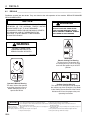
! WARNING
EQUIPMENT OPERATED IMPROPERLY OR BY UNTRAINED PERSONNEL CAN BE DANGEROUS.
Familiarize yourself with the location and proper use of all controls. Inexperienced operator’s should receive
instruction from someone familiar with the equipment before being allowed to operate the machine.
1.
2.
3.
4.
5.
6.
Safety is dependent upon the awareness, concern and
prudence of those who operate or service the equipment. Never allow minors to operate any equipment.
It is your responsibility to read this manual and all
publications associated with this equipment (Parts &
Maintenance manual, engine manual, accessories and
attachments). If the operator can not read English it is
the owner’s responsibility to explain the material
contained in this manual to them.
Learn the proper use of the machine, the location and
purpose of all the controls and gauges before you
operate the equipment. Working with unfamiliar
equipment can lead to accidents.
Never allow anyone to operate or service the machine
or its attachments without proper training and
instructions; or while under the influence of alcohol or
drugs.
Wear all the necessary protective clothing and
personal safety devices to protect your head, eyes,
ears hands and feet. Operate the machine only in
daylight or in good artificial light.
Evaluate the terrain to determine what accessories and
attachments are needed to properly and safely perform
the job. Only use accessories and attachments
approved by Jacobsen.
12. Never disconnect or bypass any switch.
13. Do not change the engine governor setting or
overspeed the engine
14. Carbon monoxide in the exhaust fumes can be fatal
when inhaled. Never operate the engine without proper
ventilation or in an enclosed area.
15. Fuel is highly flammable, handle with care.
16. Keep the engine clean. Allow the engine to cool before
storing and always remove the ignition key.
17. Place transmission in neutral, depress clutch and
engage parking brake before starting the engine
(motor). Start the engine only when sitting in operator’s
seat, never while standing beside the unit.
18. Equipment must comply with the latest federal, state,
and local requirements when driven or transported on
public roads. Watch out for traffic when crossing or
operating on or near roads.
19. Local regulations may restrict the age of the operator.
20. Operate the machine up and down the face of the
slopes (vertically), not across the face (horizontally).
21. To prevent tipping or loss of control, do not start or
stop suddenly on slopes. Reduce speed when making
sharp turns. Use caution when changing directions.
7.
Stay alert for holes in the terrain and other hidden
hazards.
22. Always use the seat belt when operating vehicles
equipped with a ROPS.
8.
Inspect the area where the equipment will be used.
Pick up all the debris you can find before operating.
Beware of overhead obstructions (low tree limbs,
electrical wires, etc.) and also underground obstacles
(sprinklers, pipes, tree roots, etc.) Enter a new area
cautiously. Stay alert for hidden hazards.
Never use a seat belt when operating vehicle
without a ROPS.
9.
Never allow anyone near the machine while in
operation. The owner/operator can prevent and is
responsible for injuries inflicted to themselves, to
bystanders and damage to property.
23. Keep legs, arms and body inside the
compartment while the vehicle is in motion.
seating
24. Always shift transmission to Neutral (Manual
Transmission) or Park (Automatic Transmission) and
engage parking brake before leaving the vehicle.
10. Do not carry passengers. Keep bystanders and pets a
safe distance away.
11. Never operate equipment that is not in perfect working
order or is without decals, guards, shields or other
protective devices securely fastened in place.
GB-3