1
~ 1IIIn IRIlfl
SERVICE INFORMATION FROM HEWLETT-PACKARD
JANUARY-FEBRUARY 1974
CLUES TO HELP
DETERMINE THE UP
PART NUMBER OF A
REPLACEMENT PART
b)' Rod Dinkins
Have you ever searched through the
parts list in an Operating and Service
Manual trying to determine the HP
part number of a needed replacement?
If so, there have probably been times
when it was difficult to determine the
desired number. It is not uncommon to
find several part descriptions that
seem to apply to the part that you need.
How do you determine which is the correct number? One way is to call your 10-
eal HP office. An even faster method,
though, is 10 use the clues given by the
part number of each part.
If you frequently use HP parts lists,
you have probably noticed that similar
parts have similar part numbers. That
is, there appears to be some pattern in
the numbering system. Although there
are variations and exceptions, the organization of the part numbering system can be broken down into three major classifications: (1) Components
and materials, (2) General usage
parts, and (3) Specific instrument
parts. A knowledge of the basic structure of the part numbering system simplifies identification of part types or
part numbers. In this article, we'll examine each classification and show
some typical examples.
Component Parts and Materials
These are items that you might expect
to find stocked at a local electronics
distributor; items that might be used
by any electronics manufacturer. For
example, transistors, ICs, transformers, capacitors, resistors, nuts,
screws, grommets, tubes, switches,
connectors, batteries, etc. For com-
The tips In this article will help you to determine needed part number•. If you need
assl.lance, Identification expert••uch a. Paul Gobin ar. available to h.lp. Pi.... contact
your local HP office.
ponent parts and materials, eight digit
part numbers are used, where the fourdigit prefix identifies the type of component, part, or material and the fourdigit suffix indicates the unique part.
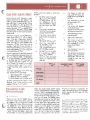
Table 1 is a list of some of the more
commonly used prefixes for component parts.
Knowing this system has two benefits;
first having information about the part
will give you clues about its part
number. For example, if the part you
are replacing is an electrolytic capacitor, you know that the HP part number
must begin with 0180-. Second,
knowing the part number gives you
helpful information about the part. For
example, if you are working on a circuit with a transistor with part number
1854-0037, you know that this transistor is an NPN made out of silicon.
Therefore you can expect to see about
0.6V across a forward-biased baseemitter junction. A transistor with an
1850- or 1851- prefix is germanium
and therefore you should expect
about O.2V drop across its B-E junction.
IN THIS ISSUE
NEW SERVICE NOTES
HIGH FREOUENCY
POWER LIMITER
PARTS IDENTIFICATION CLUES
NEW VIDEO TAPES
SERVICE TIPS
Pulse generator waveform
Magnetic tape discontinued
RACING QUIZ