1
TURBO TIPS . . . . Continued
CHANGE THE TRANSMISSION FLUID
by Robert Patton
“Matt B” submitted a tip that can save you from the fluid mess that
accompanies an automatic transmission fluid service job. Matt’s tip
also allows you to change the majority of the transmission fluid.
The “majority of the fluid;” what do you mean? In a typical drop-thepan service you are only changing about half of the fluid, there is
fluid that remains in the torque converter that does not drain. Okay,
how do you change the majority?
Matt would have been one of the contest winners, but this changethe-majority tip was presented back in Issue 42. The following is a
reprint from Issue 42. This technique can be used on ‘94-’07 trucks
with the 47RH or 48RE automatic transmission.
Owners With the ‘94 - ‘07 47RH or 48RE
If your transmission pan doesn’t have a drain plug (read: your very
first transmission fluid change), to provide for an easy fluid change,
or if you want to change all of the fluid (net change 10-12 quarts), try
this method. Pinch-off and then disconnect the return-to-transmission
cooler line from the radiator (location: driver’s side of vehicle; bottom
corner of radiator just beside the radiator coolant/fluid drain petcock).
Of the two transmission lines, this is the outboard line and (thankfully)
it is the easily accessible line. Take the 1/2” rubber hose and bend it
upward to prevent fluid drainage. Next, connect a three-foot length of
1/2” rubber “purge” hose to the metal flare coming from the radiator.
Feed your rubber hose into a five-gallon container.
Owners With the ’07.5 and Newer 68RFE
For this transmission the transmission cooler lines attach to the
cooler assembly using crimped hoses. Regardless, you can use the
same technique to remove the fluid, but you have to find a different
disconnect location. Inspection of the transmission cooler lines for
the 68RFE reveals that the entry and exit fittings to the transmission
are on the passenger side.
Which is supply, which is return? That’s why you pay your $35 TDR
subscription—the editor gets to take the 50/50 challenge in hopes of
discovering which line is the return line. Before exploratory removal,
I tried diagnostics with an infrared temperature gun hoping to see a
big temperature difference in the two fluid lines. Perhaps I should
have waited for a hot summer day, but deadlines prevail and there
was little temperature difference.
The fitting and cooler line that was easiest to reach was on the
bottom. As luck would have it, this is the return-to-transmission line.
Using a 1” wrench I disconnected it from the transmission. I found a
¾” heater hose, 3’ in length, and hose-clamped it onto the threaded
fitting. The hose was directed into a 5-gallon bucket.
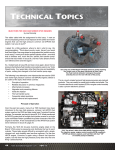
The bottom cooler line is the return-to-transmission line.
Remove it with a 1” open end wrench. Clamp a 3/4” ID hose
over the threaded barb and direct the fluid into a 5-gallon bucket.
I noticed that both the supply and return lines were held with a brace
on the driver’s side of the transmission. For extra wiggle-room when
removing the transmission pan, I removed the brace (14mm bolt)
with allows the lines to be pushed out of the way.
A view of the transmission lines from the front of a Second Generation
truck. Follow the “cold” line back to the transmission cooler and
disconnect the line at the junction point. Attach your purge hose
to the metal flare at the transmission cooler.
With the truck in Park, depress the emergency brake, chock the tires,
then start the engine. Shift the transmission into Neutral. ATF will
begin flowing into the container. Once the flow begins to dwindle,
immediately turn off the engine. This technique will yield 10-12
quarts of fluid. Re-attach the 1/2” rubber hose/cooler line to the metal
flare from the radiator. Continue with your transmission maintenance
by dropping the pan. (The fluid is gone, so you will avoid the fluid
bath that can happen with a full transmission sump.)
With the truck in Park, depress the emergency brake, chock the tires then
start the engine. Shift the transmission into Neutral and ATF will begin
flowing into the container. Once the flow begins to dwindle, immediately
turn off the engine. This technique on the 68RFE yielded 10 quarts (at
least that is how much I put back into the transmission to get it to the
proper level). Re-attach the cooler line to the transmission and continue
your transmission maintenance by dropping the pan. The pan is held on
with 8mm bolts. Remove the bolts and you’ll find that Mopar TRV sealant
holds the pan onto the body of the transmission. Start in the back corner
and lightly tap the pan. For what it is worth, there was still enough fluid
in the pan to cause a small cascade of ATF over the edge of the pan.
Better a small fluid bath than a large one? Remove the pan.
Clean the pan. Change the transmission filter. Make a decision
about installing a B&M drain plug or temperature sensor.
Clean the pan. Change the 68RFE filters. Make a decision about
installing a B&M drain plug or temperature sensor.
TDR 64
www.turbodieselregister.com
11