1
THEORY AND REFERENCE
THE AMATEUR SCIENTIST
CD-ROM
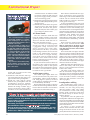
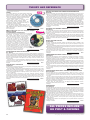
The complete collection of The Amateur Scientist articles from
Scientific American magazine. Over 1,000 classic science
projects from a renowned source of winning projects. All
projects are rated for cost, difficulty and possible hazards.
Plus over 1,000 pages of helpful science techniques
that never appeared in Scientific American.
Exciting science projects in: Astronomy; Earth
Science; Biology; Physics; Chemistry; Weather . . .
and much more! The most complete resource ever
assembled for hobbyists, and professionals looking for
novel solutions to research problems.
Includes extensive Science Software Library with even
more science tools. Suitable for Mac, Windows, Linux or
UNIX. 32MB RAM minimum, Netscape 4.0 or higher or Internet
Explorer 4.0 or higher.
Over 1,000 projects
£19.95
CD-ROM
Order code BEB2 CD-ROM
Order code BP239
£21.95
£5.49
OSCILLOSCOPES – FIFTH EDITION
Ian Hickman
Oscilloscopes are essential tools for checking circuit operation and diagnosing faults, and an
enormous range of models are available.
This handy guide to oscilloscopes is essential reading for anyone who has to use a ’scope
for their work or hobby; electronics designers, technicians, anyone in industry involved in test
and measurement, electronics enthusiasts . . . Ian Hickman’s review of all the latest types of
’scope currently available will prove especially useful for anyone planning to buy – or even
build – an oscilloscope.
The contents include a description of the basic oscillscope; Advanced real-time
oscilloscope; Accessories; Using oscilloscopes; Sampling oscilloscopes; Digital storage
oscilloscopes; Oscilloscopes for special purposes; How oscillocopes work (1): the CRT;
How oscilloscopes work (2): circuitry; How oscilloscopes work (3): storage CRTs; plus a
listing of Oscilloscope manufacturers and suppliers.
288 pages
Order code NE37
Order code NE22
£24.00
£33.99
ELECTRONIC TEST EQUIPMENT HANDBOOK
Steve Money
In most applications of electronics, test instruments are essential for checking the performance
of a system or for diagnosing faults in operation, and so it is important for engineers,
technicians, students and hobbyists to understand how the basic test instruments work and
how they can be used.
The principles of operation of the various types of test instrument are explained in simple
terms with a minimum of mathematical analysis. The book covers analogue and digital meters,
bridges, oscilloscopes, signal generators, counters, timers and frequency measurement. The
practical uses of these instruments are also examined.
206 pages
GETTING THE MOST FROM YOUR MULTIMETER
R. A. Penfold
This book is primarily aimed at beginners and those of limited experience of electronics.
Chapter 1 covers the basics of analogue and digital multimeters, discussing the relative merits
and the limitations of the two types. In Chapter 2 various methods of component checking are
described, including tests for transistors, thyristors, resistors, capacitors and diodes. Circuit
testing is covered in Chapter 3, with subjects such as voltage, current and continuity checks
being discussed.
In the main little or no previous knowledge or experience is assumed. Using these simple
component and circuit testing techniques the reader should be able to confidently tackle
servicing of most electronic projects.
96 pages
PRACTICAL ELECTRONIC FAULT FINDING AND TROUBLESHOOTING
Robin Pain
To be a real fault finder, you must be able to get a feel for what is going on in the circuit you are
examining. In this book Robin Pain explains the basic techniques needed to be a fault finder.
Simple circuit examples are used to illustrate principles and concepts fundamental to the
process of fault finding. This is not a book of theory, it is a book of practical tips, hints and
rules of thumb, all of which will equip the reader to tackle any job. You may be an engineer
or technician in search of information and guidance, a college student, a hobbyist building
a project from a magazine, or simply a keen self-taught amateur who is interested in
electronic fault finding but finds books on the subject too mathematical or specialised.
The fundamental principles of analogue and digital fault finding are described (although,
of course, there is no such thing as a “digital fault” – all faults are by nature analogue). This
book is written entirely for a fault finder using only the basic fault-finding equipment: a digital
multimeter and an oscilloscope. The treatment is non-mathematical (apart from Ohm’s law)
and all jargon is strictly avoided.
274 pages
Order code AS1 CD-ROM
BEBOP BYTES BACK (and the Beboputer Computer
Simulator) CD-ROM
Clive (Max) Maxfield and Alvin Brown
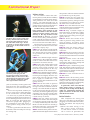
This follow-on to Bebop to the Boolean Boogie is a multimedia
extravaganza of information about how computers
work. It picks up where “Bebop I’’ left off, guiding you
through the fascinating world of computer design . .
. and you’ll have a few chuckles, if not belly laughs,
along the way. In addition to over 200 megabytes
of mega-cool multimedia, the CD-ROM contains a
virtual microcomputer, simulating the motherboard
and standard computer peripherals in an extremely
realistic manner. In addition to a wealth of technical
information, myriad nuggets of trivia, and hundreds of
carefully drawn illustrations, the CD-ROM contains a
set of lab experiments for the virtual microcomputer that
let you recreate the experiences of early computer pioneers.
if you’re the slightest bit interested in the inner workings of
computers, then don’t dare to miss this!
Over 800 pages in Adobe Acrobat format
CD-ROM
Order code PC109
£9.95
DIGITAL GATES AND FLIP-FLOPS
Ian R. Sinclair
This book, intended for enthusiasts, students and technicians, seeks to establish a firm
foundation in digital electronics by treating the topics of gates and flip-flops thoroughly and
from the beginning.
Topics such as Boolean algebra and Karnaugh mapping are explainend, demonstrated and
used extensively, and more attention is paid to the subject of synchronous counters than to the
simple but less important ripple counters.
No background other than a basic knowledge of electronics is assumed, and the more
theoretical topics are explained from the beginning, as also are many working practices.
The book concludes with an explanation of microprocessor techniques as applied to
digital logic.
200 pages
Order code PC106
£9.05
UNDERSTANDING ELECTRONIC CONTROL SYSTEMS
Owen Bishop
Owen Bishop has produced a concise, readable text to introduce a wide range of students,
technicians and professionals to an important area of electronics. Control is a highly
mathematical subject, but here maths is kept to a minimum, with flow charts to illustrate
principles and techniques instead of equations.
Cutting edge topics such as microcontrollers, neural networks and fuzzy control are all here,
making this an ideal refresher course for those working in Industry. Basic principles, control
algorithms and hardwired control systems are also fully covered so the resulting book is a
comprehensive text and well suited to college courses or background reading for university
students.
The text is supported by questions under the headings Keeping Up and Test Your Knowledge
so that the reader can develop a sound understanding and the ability to apply the techniques
they are learning.
228 pages
Order code NE35
£24.99
HOW ELECTRONIC THINGS WORK – AND WHAT TO DO WHEN THEY DON’T
Robert Goodman
You never again have to be flummoxed, flustered or taken for a ride by a piece of
electronics equipment. With this fully illustrated, simple-to-use guide, you will get a grasp
on the workings of the electronic world that surrounds you – and even learn to make your
own repairs.
You don’t need any technical experience. This book gives you: Clear explanations of how
things work, written in everyday language. Easy-to-follow, illustrated instructions on using test
equipment to diagnose problems. Guidelines to help you decide for or against professional
repair. Tips on protecting your expensive equipment from lightning and other electrical damage.
lubrication and maintenance suggestions.
Covers: colour TVs, VCRs, radios, PCs, CD players, printers, telephones, monitors,
camcorders, satellite dishes, and much more!
394 pages
Order code MGH3
£21.99
VINTAGE RADIOS
Tony Thompson
Since the 1920s the radio set has been an important part of most people’s lives. In the thirties
and forties the wireless was an important piece of furniture and a potent symbol of status;
beautifully made floor-standing and table-top sets in veneered wood and trendy Bakelite
became the focal points of living rooms up and down the land. After the war the emphasis
began to change towards portability, and the change from valves to transistors in the 1960s
changed the radio into a more useful but far less interesting object.
The book tells the collector, and the armchair wireless enthusiast, everything he or
she needs to know about classic radios from the 1920s to the end of the 1960s. All the
important makes and models are discussed, and the author also covers buying and
selling, care and restoration, and many other topics, including foreign radios and radiorelated ephemera.
Illustrated with hundreds of colour photographs, this is the perfect collector’s companion to
the fascinating topic.
208 pages - hardback
Order code CVR
£21.95
ALL PRICES INCLUDE
UK POST & PACKING
68
Everyday Practical Electronics, February 2009