1
IT’S TIME TO INSPECT YOUR HARMONIC DAMPER
(But please don’t call it a balancer)
by David Magnoli
As my truck nears the 90,000 mile mark, I thought I would take
a look at the owner’s manual to see what the recommended
maintenance was for that milestone just in case I were to forget, or
was unaware of, some suggested repair. I always read the manual
when I buy a vehicle, but often forget how much useful information
is in it. Under the 90K schedule was the recommendation of “Inspect
Damper”. I also noticed that this same prompt was listed at 30K and
60K. My first thought was that this referred to the steering damper
(4x4). Not entirely sure, I looked it up in my service manual and
found that it was not steering-related at all but was instead pointing
me to that often overlooked, and for the most part, forgotten item
more properly called the harmonic damper that sits on the front
end of the engine’s crankshaft directly in front of, and part of, the
serpentine-belt pulley. Like a lot of people, I suppose, I never paid
much attention to this black doughnut, and did not realize that
it required any sort of inspection or maintenance. It does in fact
deserve our attention and in the process of doing so, I learned
quite a bit about this important piece of our Mighty Cummins
Diesel engine.
What Is a Damper and What Does It Do?
Although often referred to as the harmonic balancer, because
our Cummins is internally balanced (the crankshaft itself being
balanced), the damper on our engines does not balance the
engine. It damps harmonic vibrations and, as such, is a harmonic
damper. Other diesel pickup engines are externally balanced and
in addition to the damper, have a counter-weight either made as
part of the damper, or bolted on in addition to it to provide the
balancing requirement.
With each firing of the fuel/air charge in the cylinder, there is a
violent but short-duration deformation or twist of the crankshaft as
the force of the power stroke drives the crank against the resistance
of the driveline. This occurs with each ignition event and results
in the repeated twist and untwist of the crankshaft as this force
alternately begins and ends, momentarily forcing the crank past
its normal rotation, and then allowing the crank to rebound after
each firing. This spring effect is more pronounced in a straight-six
engine with its longer crankshaft than with the shorter crankshaft
of a V configuration. It is also more pronounced at the front end
of the crankshaft where there is less rotational resistance than at
the transmission end.
While the torque-converter or clutch/flywheel will offer minimal
vibration damping at the rear of the engine due to their mass, they
do nothing for the front end of the crankshaft, which will experience
a greater degree of twist/rebound under power. This is also more
of an issue in modified high-power engines with higher cylinder
pressures and the associated higher crank torque-spikes. Varying
with the speed and load of the engine, these firing impulses
and rebound forces can, and do, set up harmonic and torsional
vibrations in the crankshaft. And because it is the front of the
crankshaft that drives the injector pump as well as the camshaft,
increased vibrations and harmonic twisting can negatively affect
their function as well.
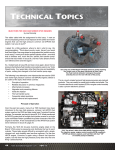
The 5.9 stock damper uses a rubber ring between the
cast hub and the machined-steel pulley/inertia ring to
dampen the firing impulses of the Cummins engine.
This picture clearly shows the degradation of this rubber,
as well as the section that is missing, which caused it to
wobble on Cliff Scott’s engine. This should motivate the
reader to inspect this important, but often-overlooked part,
and make sure there are no signs of failure on your own truck.
Surprisingly, the index marks are still in alignment on this
damper, but this one should have been replaced some time ago.
44 www.turbodieselregister.com TDR 73
Our engine cranks have a natural resonance inherent to their
design, which means that they tend to vibrate much more at certain
specific frequencies than others. When the power pulses are in
phase with this natural tendency to vibrate, this will result in lost
horsepower, increased bearing wear, unstable valve and injectorpump operation as well as the effects being felt in the vehicle.
Harmonics are the frequencies that are smaller, less pronounced
multiples of the primary resonance.
Everything has a natural resonance at which it will vibrate. Think
of a piano with its many strings. The long and thick strings will
vibrate slowly. Short and thinner wires will vibrate faster and,
because they are connected to a soundboard, they allow you to
hear these vibrations as sound. Hit a 2x4 with a hammer and it will
vibrate also at a fixed frequency determined by its size, mass, and