1
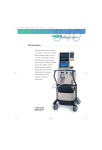
840 Ventilator System
The 840™ Ventilator is an evolution in critical care ventilators. Compact and lightweight, it delivers sensitive,
precise breaths to critically ill infant, Paediatric and adult patients. With its high-performance pneumatics
and dual-microprocessor electronics, the 840 platform will accommodate technology updates well into the
21st century.
Features & Specifications
Intelligent User Interface
Tidal volume (VT): 25 to 2,500 mL
• DualView™ liquid crystal display (LCD) Touch
Respiratory rate (f): 1.0 to 100 /min
.
Peak inspiratory flow (V MAX): 3 to 150 L/min for
Screens display monitored data separately from
ventilator settings for easy assessment of your
patient’s condition.
• The SandBox™ screen area lets you set up and
IBW > 24 kg; 3 to 60 L/min for IBW ≤ 24 kg
Flow pattern: Square or descending ramp
Plateau time (TPL): 0.0 to 2.0 seconds
review all proposed ventilator and alarm limit
Inspiratory pressure (PI): 5 to 90 cmH2O
settings before you apply them to your patient.
Constant during rate change: Inspiratory time (TI),
You can change any proposed setting or press
the CLEAR key to cancel. No settings are applied
to the patient until you press the ACCEPT key.
• The SmartAlert™ Alarm System prioritizes
I:E ratio, or expiratory time (TE)
Inspiratory time (TI): 0.2 to 8.0 seconds
I:E ratio: ≤ 1:299-4.00:1
Expiratory time (TE): TE ≥ 0.2 second
distinguished from secondary, dependent
Trigger type: Pressure (PTRIG) or flow
.
(V TRIG, Flow-by® flow triggering)
alarms, which helps you to efficiently resolve
Pressure sensitivity (PSENS): 0.1 to 20 cmH2O
root causes of alarms.
below PEEP
.
Flow sensitivity (V SENS): 0.5 to 20 L/min
alarm annunciation. Primary alarms are
• The setting for ideal body weight (IBW)
establishes boundaries that help prevent
O2%: 21% to 100%
application of inappropriate ventilator settings.
PEEP: 0 to 45 cmH2O
• Entering Ideal Body Weight (IBW) automatically
creates default settings and alarm limits which
may either be quickly accepted for rapid setup
or adjusted as needed.
• Once settings are applied, the ventilator offers
Apnea ventilation: Apnea mandatory type: volume
control (VC) or pressure control (PC)
Apnea flow pattern: Square or descending ramp
.
Apnea peak flow (V MAX): 3 to 150 L/min for
IBW > 24 kg; 3 to 60 L/min for IBW ≤ 24 kg
an “undo” function that allows you to return to
Apnea inspiratory pressure (PI): 5 to 90 cmH2O
previous settings quickly and easily.
Apnea inspiratory time (TI): 0.2 to 8.0 seconds
Apnea interval (TA): 10 to 60 seconds
Ventilator Settings
Ideal body weight (IBW): 7.7 to 330.7 lb
(3.5 to 149 kg)
Modes: Assist/Control (A/C), synchronous
intermittent mandatory ventilation (SIMV), or
spontaneous (SPONT). Optional BiLevel™.
Spontaneous breath types: Pressure supported
(PS) or none
Pressure support (PSUPP): 0 to 70 cmH2O
Flow acceleration %: 1% to 100%
Expiratory sensitivity (ESENS): 1% to 45%
Mandatory breath types: Volume control (VC) or
pressure control (PC)
Apnea respiratory rate (f): 2.0 to 40 /min
Apnea O2%: 21% to 100%
Apnea I:E ratio: ≤ 1.00:1
Apnea expiratory time (TE): Te ≥ 0.2 second
Disconnect sensitivity (DSENS): 20% to 95%
Humidification type: Heat-moisture exchanger
(HME), non-heated expiratory tube, or heated
expiratory tube
Patient circuit type: Pediatric or adult