1
Safety Recommendations
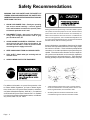
WARNING: FOR YOUR SAFETY AND THE SAFETY OF
OTHERS, READ AND UNDERSTAND THE SAFETY RECOMMENDATIONS AND OPERATING INSTRUCTIONS BEFORE USING THIS TOOL.
1.
KNOW YOUR POWER TOOL – Read your operating
and service manual carefully. Learn its applications and limitations as well as the specific potential hazards particular to this tool.
2.
DISCONNECT TOOLS – when not in use, before servicing, when changing accessories such as grippers and draw rods, etc.
3.
AVOID AGAINST ACCIDENTAL STARTING – Do not
carry the tool with your finger on the switch. Be
sure the shut off valve is in the off position before
connecting the air supply to this tool.
4.
KEEP HANDS AWAY FROM ALL MOVING PARTS.
5.
STAY ALERT – Watch what you are doing and use
common sense.
6.
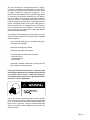
ALWAYS WEAR PROTECTIVE EQUIPMENT:
For additional information on eye and face protection, refer
to Federal OSHA Regulations, 29 Code of federal regulations, Section 1910.133 eye and Face Protection, and American National Standards Institute, ANSI A87.1, Occupational
and Educational Eye and Face Protection Z87.1 is available
from the American National Standards Institute, 1430 Broadway Avenue, New York, NY 10018.
Page - 2
Hearing protectors are required in high noise areas, 85dBA or greater.
The operation of tools and equipment in the area, reflective surfaces,
process noises and non-resonant structures can substantially contribute to and increase the noise level in the area. For additional information on hearing protection, refer to Federal OSHA Regulations section 1910.95 Occupational Noise Exposure, and the American National
Standards Institute, ANSI S12.6 Hearing Protectors.
Some individuals are susceptible to disorders of the hands
and arms when exposed to task which involve highly repetitive motions or vibration. Those individuals predisposed to
vasculatory or circulation problems may be particularly susceptible. Cumulative trauma disorders such as carpal tunnel syndrome and tendonitis can be caused by repetitions,
forceful exertions of the hands and arms. These disorders
develop gradually over periods of weeks, months, and years.
•
Tasks should be performed in such a manner that the
wrists are maintained in a neutral position which is not
flexed, hyperextended, or turned side to side.
•
Stressful postures should be avoided and can be
controlled through tool selection and work location.