1
system to allocate a class number, if available,
and the request to complete immediately. Logical
unit zero is a dummy I/O device.
• When the WRITE/READ call completes, PROGA's
data will have been placed in the buffer and this
fact recorded in the completed class queue for this
class.
• PROGA then schedules PROGB, the program receiv
ing the data and passes to PROGB, as a parameter,
the class number it obtained.
i When PROGB executes it picks up the class number
and issues a Class I/O GET call to the class. PROGA's
data is then passed from the system buffer to
PROGB' s buffer.
Another application of Class I/O is in the operation
of the SPOUT program (see below).
linked to the system. The resultant program is tested
for correct function. In the rare case where it passes
all tests, the program is "developed" and activity on
it stops here until a failure is discovered by unsatis
fied users or a logic error appears. Fixes are made to
the source program to correct logic or design errors
or to add features. The development loop now closes
by going back through the language processor.
While traversing this loop we invoked a language
processor, a loader, the user's program, and an editor.
To ease the path around the loop in RTE-II we pro
vide a high-level set of control programs, the batch/
spool monitor. In the RTE-II development project
considerable effort went into enhancing the editor,
the loader, and the batch control capability.
The RTE-II system has a new program editor, de
signed to make it easy to edit programs (it comes in
second best on text). The editor is inherently string
and line oriented. It can find, replace, and delete
strings. It can easily insert, replace, or delete charac
ters in a line. It talks to the file system and it is fast.
The loader was enhanced in control capability, but
the primary effort was aimed at improving its speed.
To this end the system generator now provides a dic
tionary for all library entry points, and a study of
where the loader spent its time led to faster symbol ta
ble search routines.
System enhancements for batch/spool consist of an
LU switch capability, a batch clock and a break re
quest. LU switch is a mechanism that allows pro
grams running under control of the batch monitor to
talk to a given logical unit while the actual LU is
some other device. The batch monitor sets up the
switches in a table that is accessable by the I/O sys
tem. Only programs running under the batch moni
tor are switched. This allows the batch monitor to
switch output for the printer, for example, to a spool
file from which it will be printed at a later time. The
batch clock is an execution-time clock that is ad
vanced every time the system clock is advanced
(each 10 milliseconds), but only if a batch program is
running. If the batch clock goes to zero it indicates a
run-time limit has been exceeded and the offending
program is aborted by the system. Batch elapsed time
is not kept, since it is meaningless in a multiprogram
ming system. The break request is a system request
which sets a flag for the specified program. The pro
gram may examine this flag and take any action it
deems appropriate. When the batch monitor sees this
flag it will abort any job it is running, or, if not in a
job, will stop whatever it is doing and go back to the
terminal for commands.
Program Development
Before a newly delivered system can become use
ful (unless its intended use is program development)
programs must be developed to solve the users' prob
lems. The development of programs will, in most
cases, continue for the life of the system as the user ex
pands or changes his processes.
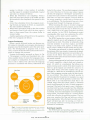
Program development proceeds as shown in Fig.
4. The program is written and translated into a ma
chine-readable format. It enters the language proces
sor (compiler or interpreter); if errors are found the
source code is edited. The code from the language
processor is combined with library subroutines and
New Code
(Linkage
Edit)
Minor Flow
• — Control
Good
Program
Fig. 4. A model of the program development cycle, showing
the utility programs that play roles in it. For RTE-II, major
improvements have been made in the editor and loader, and a
new batch/spool monitor has been developed.
Batch/Spool Capability
The RTE-II batch and spooling capability is an ex
tension of the file management package of RTE. The
16
© Copr. 1949-1998 Hewlett-Packard Co.