1
APPLICATION
Applications with Thermal Blankets
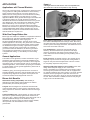
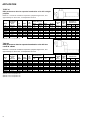
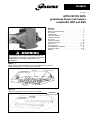
Figure 2.1
Centrifugal blower fan with electric motor and adjustable belt
drive. Motor and controls are exposed for easy servicing.
Since most of the heat used in a greenhouse is required at night,
many growers are adding thermal blankets to reduce heating
space and heat loss through the roof of the greenhouse. In
addition there is a strong trend to use under-the-bench heating
systems for greater efficiency and fuel savings. For these
applications Modine offers gas-fired blower-type unit heaters with
a discharge transition for use with polytube for heated-air
distribution below the thermal blanket even down to the ground
level. Blower-type units permit effective air distribution against
static resistances up to 0.4 inches W.C. (0.5" W.C. High
Efficiency II), so they can be suspended above the thermal
blanket, and connected to a polytube via two 90-degree elbows
or thick walled flexible plastic tubing. Operation then can be
controlled with a simple low-cost thermostat located below the
thermal blanket and at plant level.
Wide Size Range Widens Use
Blower-type unit heaters are available in 6 separated combustion
sizes ranging from 130,000 to 340,000 BTU/HR input, 12
standard and High-Efficiency sizes ranging from
50,000 to 400,000 BTU/HR input. The wide range of sizes
enables application in almost any size greenhouse. The addition
of a discharge transition and polytube permits uniform heated
air distribution throughout a variety of greenhouses. With the
versatility of the size range, and the option of overhead or
ground level heated-air distribution, the blower-type heaters
may be applied for total heating of greenhouses, for add-on
or supplemental heating, or, as a standby for other heating
systems.
General Applications
This bulletin covers application, location and selection of gasfired blower-type unit heaters in greenhouse installations only.
Modine propeller and blower-type unit heaters, with a single fan
and electric motor, are most frequently used in commercial and
industrial applications, where natural or propane gas is available.
For further details on these general applications, please refer to
Modine Circular 6-107.
Installation, piping, and venting instructions are covered in a
separate installation and service manual shipped with each unit.
A specific wiring diagram for the ignition control system and
accessories ordered is also shipped with each unit.
Blower Unit Benefits
Greenhouse heating compatibility. With flexibility of
application and fast heating response blower unit heaters
provide healthy and uniform plant growth.
Long-life. Heat exchangers are aluminized steel tubes with
contoured airfoil design to resist corrosion and eliminate noise
during expansion or contraction. Stainless steel heat exchanger
optional.
Lower installation cost. A large selection of motors and drives
allow units to operate efficiently against static resistances as
high as 0.5" W.C., without overloading motor. With longer runs of
polytube substantial savings can be realized on large
installations by reducing number of heaters required. Smaller,
less expensive units are available for use in smaller
greenhouses.
2
Faster warm-up, long throw. No combustion chamber. Flames
burn within individually-fired heat exchanger tubes. Direct firing
into tubes with heat evenly distributed throughout length of tube
results in quicker heat longer heat-throw. Fuel dollars are saved
and comfort is assured at all times.
Less maintenance to keep these units operating at top
efficiency. Aluminized steel burner ports have extra large
openings. Knife-sharp port edges prevent lodging of dirt or
scale…makes burners self-cleaning, thereby reducing cost of
maintenance.
Easier to service. To facilitate servicing, the complete burner
assembly may be removed as a single unit. Casing bottom is
hinged for easy removal and replacement of burner. Controls
are completely exposed for easy access.
Improved combustion efficiency cuts fuel bills. Burner tube
design allows adequate supply of air to reach flame.
Result…fuel dollars are not wasted due to poor design. Further
fuel savings are possible when blower units are equipped with
an optional intermittent pilot control system. The system provides
automatic electric spark ignition of pilot and main burner on
demand for heat. The pilot is lit only as long as thermostat calls
for heat. When thermostat is satisfied, the burner and pilot gas
supply are shut off simultaneously.