1
special precautions
SPECIAL PRECAUTIONS
THE INSTALLATION AND MAINTENANCE INSTRUCTIONS IN THIS
MANUAL MUST BE FOLLOWED TO PROVIDE SAFE, EFFICIENT AND
TROUBLE-FREE OPERATION. IN ADDITION, PARTICULAR CARE
MUST BE EXERCISED REGARDING THE SPECIAL PRECAUTIONS
LISTED BELOW. FAILURE TO PROPERLY ADDRESS THESE
CRITICAL AREAS COULD RESULT IN PROPERTY DAMAGE OR
LOSS, PERSONAL INJURY, OR DEATH. these instructions
Subject to any more restrictive local or national
codes.
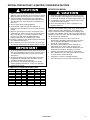
hazard intensity levels
1.
2.
3.
4.
DANGER: Indicates an imminently hazardous situation which, if not avoided, WILL result in death or serious injury.
Warning: Indicates a potentially hazardous situation which, if not avoided, COULD result in death or serious injury.
CAUTION: Indicates a potentially hazardous situation which, if not avoided, MAY result in minor or moderate injury.
IMPORTANT: Indicates a situation which, if not avoided, MAY result in a potential safety concern.
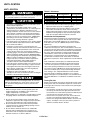
danger
Appliances must not be installed where they may be exposed
to a potentially explosive or flammable atmosphere.
warning
1. Gas fired heating equipment must be vented - do not operate unvented.
2. A built-in power exhauster is provided - additional external power exhausters are not required or permitted.
3. If you are replacing an existing heater, it may be necessary to resize the venting systems. Improperly sized venting systems can result in vent gas leakage or the formation of condensate. Refer to the National Fuel Gas Code ANSI Z223.1 or CSA B149.1 latest edition. Failure to follow these
instructions can result in injury or death.
4. Under no circumstances should two sections of double wall
vent pipe be joined together within one horizontal vent system
due to the inability to verify complete seal of inner pipes.
5. All field gas piping must be pressure/leak tested prior to operation. Never use an open flame. Use a soap solution
or equivalent for testing.
6. Gas pressure to appliance controls must never exceed 14" W.C. (1/2 psi).
7. To reduce the opportunity for condensation, the minimum sea level input to the appliance, as indicated on the serial plate, must not be less than 5% below the rated input,
or 5% below the minimum rated input of dual rated units.
8. Disconnect power supply before making wiring connections to prevent electrical shock and equipment damage.
9. All appliances must be wired strictly in accordance with wiring diagram furnished with the appliance. Any wiring different from the wiring diagram could result in a hazard to persons and property.
10.Any original factory wiring that requires replacement must be replaced with wiring material having a temperature rating of at least 105°C.
11.Ensure that the supply voltage to the appliance, as indicated on the serial plate, is not 5% greater than the rated voltage.
12.When servicing or repairing this equipment, use only factory-approved service replacement parts. A complete replacements parts list may be obtained by contacting the factory. Refer to the rating plate on the appliance for complete appliance model number, serial number, and company address. Any substitution of parts or controls not approved by the factory will be at the owners risk.
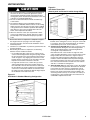
caution
1. All literature shipped with this unit should be kept for future use for servicing or service diagnostics. Do not discard any literature shipped with this unit.
2. Consult piping, electrical, and venting instructions in this manual before final installation.
3. Do not attach ductwork, air filters, or polytubes to any propeller unit heater.
4. Clearances to combustible materials are critical. Be sure to
follow all listed requirements.
5. Do not locate units in tightly sealed rooms or small compartments (commonly referred to as confined spaces) without provisions for adequate combustion air and venting.
Combustion air must have access to the confined space through a minimum of two permanent openings in the enclosure, at least one near the bottom. They should provide a free area of one square inch per 1,000 BTU/Hr input rating of the unit with a minimum of 100 square inches for each opening, whichever is greater.
6. Low profile heaters are designed for use in heating. applica tions with ambient temperatures between -40°F and 90°F.
7. Do not install unit outdoors.
8. In garages or other sections of aircraft hangars such
as offices and shops that communicate with areas used for
servicing or storage, keep the bottom of the unit at least
7' above the floor unless the unit is properly guarded
to provide user protection from moving parts. In parking
garages, the unit must be installed in accordance with
the standard for parking structures ANSI/NFPA 88A, and
in repair garages the standard for repair garages NFPA
#88B. In Canada, installation of heaters in airplane
hangars must be in accordance with the requirements
of the enforcing authority, and in public garages in
accordance with the current CSA-B149 codes.
9. In aircraft hangars, keep the bottom of the unit at least 10' from the highest surface of the wings or engine enclosure of the highest aircraft housed in the hangars and in accordance with the requirements of the enforcing authority
and/or NFPA 409-latest edition.
10.Installation of units in high humidity or salt water atmospheres will cause accelerated corrosion resulting in a
reduction of the normal life of the units.
11.Do not install units below 7' measured from the bottom of the unit to the floor in commercial applications (unless
unit is properly guarded to provide user protection from moving parts)and 5' measured from the bottom of the unit to the floor in residential applications.
12.Be sure no obstructions block air intake and discharge of unit heaters.
13.The minimum distance from combustible material is based
on the combustible material surface not exceeding 160°F. Clearance from the top of the unit may be required to be greater then the minimum specified if heat damage, other than fire, may occur to materials above the unit heater at the temperature described.
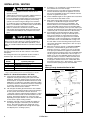
14.Allow 18" of clearance at rear (or 6" beyond end of motor at
rear of unit, whichever is greater) and access side to provide ample air for combustion and proper operation of fan.
15. Installation must conform with local building codes or in the
absence of local codes, with Part 7, Venting of Equipment,
of the National Fuel Gas Code, ANSI Z223.1 (NFPA 54) - latest edition. In Canada installation must be in accordance
with CSA-B149.1.
16.Purging of air from gas supply line should be performed as
described in ANSI Z223.1 - latest edition “National Fuel Gas Code”, or in Canada in CSA-B149 codes.
VHHP6-583.1