1
Digital Phosphor Oscilloscopes
TDS7000 Series
Why is Delta-time Accuracy
a Critical Specification?
Accurate time interval (delta-time)
measurements are critical when
validating and characterizing
design performance. New standards such as 3GIO, HyperTransport and InfiniBand operate
at extreme clock speeds and
timing margins. Delta-time
accuracy is the most important
specification for timing measurements because it determines
how close these measurements
will be to the real values. It takes
into account both repeatability
and resolution specifications
and includes effects from both the
horizontal and vertical sytems.
Delta-time accuracy specifies
the deviation from the actual
value. It is based upon a number
of factors, including sample
interval, quantization error,
interpolation error, amplifier
noise, time base accuracy and
sample clock jitter. Because
each of these factors contributes
to the timing error, the combination of them determines the
delta-time accuracy specification.
While individual factors such as
time base accuracy or sample
interval are important, it is the
aggregate performance of the
entire digitizing system that
determines measurement accuracy. Thus, delta-time accuracy
is a critical specification for
applications such as setup and
hold time verification, characterization of skew and jitter analysis
where timing is the fundamental
characteristic being measured.
2
Exceptional delta-time measurement
performance provides dependably accurate
measurements of the time interval between
two events. And, the combination of exceptional
trigger and acquisition performance, deep
memory and application-specific software make
the TDS7000 Series a high-performance jitter
and timing analysis tool.
Superior probing performance is critical to
the fidelity of your measurement system. The
P7240 4 GHz (120 ps rise time) active probe
faithfully acquires real-time signal information
from high-speed designs with high-impedance,
high-frequency circuit elements that demand
minimal loading. The P7260 provides 6 GHz
bandwidth and switchable 5x and 25x attenuation modes for wide dynamic range. The
P7330 3.5 GHz (<130 ps typical rise time)
differential probe provides high CMRR, broad
frequency range, and minimal time skew
between inputs.
The TDS7154, TDS7254 and TDS7404
models include the TekConnect ™ signal
interconnect system, which further ensures
superior signal fidelity, while offering unparalleled versatility with the world’s widest array
of accessory signal acquisition solutions for
high-performance, real-time oscilloscopes.
This convenient, positive locking interface
replaces the traditional BNC connectors and
is compatible with the P7000 Series probes.
The TCA-1 MEG high-impedance buffer amplifier allows you to make high-voltage and
micro-volt differential, current and other
general-purpose voltage measurements using
existing Tektronix probing solutions that require
a 1 MΩ termination. In addition, this amplifier
provides input coupling (AC/DC/GND) and
bandwidth limit (100 MHz, 20 MHz).
Digital Phosphor Oscilloscopes • www.tektronix.com/tds7000
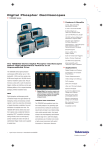
Figure 1. Advanced digital phosphor
technology provides unprecedented
waveform capture rate, maximizing the
probability of discovering hidden faults
and revealing dynamic signal behavior.
Industry-leading Waveform
Capture Rate
The successful discovery of intermittent faults
and characterization of complex, dynamic
signals depend on the amount of time the
signal is observed by the oscilloscope. With
the TDS7000 Series you can fully visualize
signal activity, because third-generation digital
phosphor technology (DPX) provides waveform
capture rates of more than 400,000 waveforms
per second. DPX has saved countless designers
minutes, hours, or even days, by quickly
revealing the nature of faults so you can apply
the TDS7000’s sophisticated triggering to
isolate them.