1
United
3,005,791
E08
Patented Oct. 24., 1961
l
2
ing action to form homogeneous masses of mixed mate
rials.
' 3,005,791
FLOORING MATERIALS
John W. Church, Newburgh, N.Y., assignor, by mesne
assignments, to The Ruheroid Co., South Bound Brook,
The masses are suitably sheeted out in manners
well known to the art, such as being further incorporated
on a two-roll mill, at which time marbleizing stock may
or many not be added; and reducing to desired thickness
N.J., a corporation of New Jersey
by passing through a train of calender rolls, while being
Filed Sept. 18, 1957, Ser. No. 684,706
9 Claims. (Cl. 260-47)
maintained at an elevated temperature suitable to produce
ductility, and the required adhesion to the calender rolls.
The ?nished sheet is partially cooled, and now may be
coverings and is herein described as embodied in what 10 cut into sheets or tiles of any required size, or rolled up
may be called:
into rolls. This is the typical and rather well-known,
This invention relates to compositions suitable for floor
(1) A grease-resistant asphalt tile, although the tile
so-called “Asphalt Tile” process.
contains no asphalt, as covered by Federal Speci?cation
SS-T-307.
In most cases, the original calendered sheet is cut up
immediately into tiles, and any ‘border, as well as rejected
(2) A vinyl tile conforming to the Type I description 15 tiles, are returned for reprocessing along with the new
under L-T-75l.
batch. The system is completely thermoplastic, and the
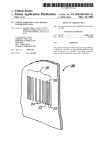
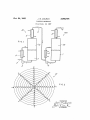
In the drawing FIG. 1 is a diagrammatic sketch of
product resoftens to workability as soon as its tempera
apparatus for carrying out the chlorination of paraf?n;
ture is elevated to the desired point. In order that the
and FIG. 2 is a top plan View of a mold test transparency
?nished composition may pass the grease-resistant prop—
gauge.
20 erties of SS-T-307, as well as the other requirements, the
In ?ooring compositions, great resistance is a highly
selection of the ingredients used must be carefully made,
desirable characteristic. Asphalt tile, as it is now made
to conform to Federal Spec?cation SS-T-306b, is not
and the processing conditions must also be carefully con
trolled.
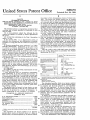
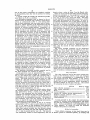
This tile (3.08/1 ratio-P45/vinyl) gave the ‘follow
mg test results, when tested in accordance with Federal
made so as to be grease resistant. A limited amount of
so-called asphalt tile is made to conform to the require
ments of grease-resistant tile, Federal Speci?cation SS
Speci?cation SS—T-307:
T~307. However, special synthetic resins, considerably
more costly than those used in the SS-T-306b type, are
Sample
required, and the cost of the resultant product is so high
as to limit its use.
Specimen
SS-T-307 Requirements
30
There are other forms of ?ooring compounds which
are grease resistant, such as the vinyl tiles under Federal
Speci?cations L-T-751 and certain linoxin or linoleum
One-minute penetration (mils)____
Ten-minute penetration (mils)____
9. 4
14. 7
6.0 to 15.0.
Maximum allowed (mils) _______ __
Indentation at; 115° F. (mils) ____ _-
14.8
32.0
1.4.8.
36.0.
types, as well as certain types of vinyl compositions lami
Impact __________________________ __
O.K.
Shall not crack or
nated to felt or other cellulosic backings.
All of such
De?ection _________ _.
__.-
>2”
Not less than .4”.
other products, however, have disadvantages in one form
Curl ______________ ._
_-__
. 015
Not greater than .030.
break.
Oil & Alkali Resistance 1 (Scratch
or another, such as:
width :
(a) High cost.
(b) Failure to pass the curling requirements of both
such high Wetting power and, at the same time, such ex
cellent grease resistance, that it may be combined with
relatively large amounts of low-priced ?llers, such as
ground limestone, asbestos ?bre and pigmentsv for color,
. O55
___
.125
do____
.130
Not greater than .170
D0.
- '
ated cottonseed oil) .1
SS-T~306b and SS-T-307.
I have discovered that an economical composition,
‘made conforming to all the desirable characteristics of
SS-T-307, may be produced by combining a certain type
of chlorinated para?‘in with a certain type of vinyl poly
mer or copolymer, to form an organic hinder which has
Control _____________ _.Inches_.
Lar __________________ __
Wesson Oil (hydrogen-
-
Kerosene ______________ __do.___
2% TSP ______________ __do____
d
.100
Do.
. 055
D0.
9.000 \/ID3x8.992 to 9.008.
Sue ----------------------- -~
9.000 AMDA
Thickness (Gauge) ________ __do-___ 3/8” (.125) I .120 to .130.
45
1 Covering both class 1 and class 2 oil and alkali resistance tests.
2 Wesson Oil (hydrogenated cottonseed oil) used as a substitute for
cottonseed oil.
3 Machine direction.
4 Against machine direction.
The chlorinated para?in, which is not grease resistant
so as to give a highly serviceable, curlproof, grease resis 50 in and of itself, is converted into a grease-resistant binder
by complete and thorough solution in, and miscibility
taut, ?ooring material.
with, the vinyl copolymer. If, for any reason, the asso
This product may be formed in large sheets, or may
ciation is incomplete, or the two do not remain in com—
be marketed in the form of tiles of any convenient size.
It may also be produced in a variety of thicknesses. A
plete miscibility with each other, and if the chlorinated
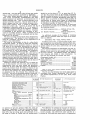
typical composition of such a product is as follows:
55 para?‘in tends to sweat or exude from the gelled mass
obtained, then the grease-resistant properties will be
EXAMPLE #l.—-GREASE RESISTANT
found wanting.
ASPHALT TILE
P-45 chlorinated parai?n ______________ __v___.. 14.890
Vinyl copoly-mer __________ __>______________ __
Polymerized rosin
Stabilizer1
__
vinyl polymers and copolymers in the ranges described
.875 60 herein. Only by careful chlorination of the paraf?nic
4.850
.260
Ground limestone _________________________ __ 56.825
7R
asbestos ?bre ________________________ m. 19.300
Pigment
‘
__
It should be understood that para?inic materials, in
and of themselves, are not miscible nor compatible with
3.000
100.000
1 Such as epoxy resin, barium cadmium laureate, barium ricinoleate,
and others.
hydrocarbon to at least 45%, may the para?n be ren
dered soluble in,’ and permanently miscible with, the
vinyl polymer. Furthermore, if the chlorination is car
65 ried out in such a way that either:
(a) Portions of the paraf?n are chlorinated to a low
degree, even though the average chlorine content may
be at the proper level, the chlorinated produce will take
on the characteristics of the least chlorinated fraction,
The ingredients are placed together in an intensive 70 and, therefore, cause impermanent miscibility, with the
resultant loss in grease-resistant properties; or still further,
Perkins mixer, and fluxed together by an intensive knead—
(b) If the chlorination is not controlled so that prod
internal mixer, such as a Banbury mixer or a Baker &