1
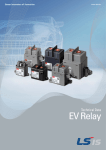
EV Relay Technical Data
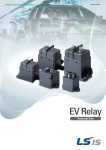
EV Relay
03
Precautions
Safety Precautions
Features
Specification range
Compact Design
Achieved overall compact size with short gap cutoff,
charged with Hydrogen and Nitrogen Gas.
Proven Safety
High Short-time short circuit current with
stand value.
Superior Reliability
Excellent performance with electrical and
mechanical endurances.
Customizable
Relays are customizable to meet customers`
requirements such as mounting position, etc.
Use that exceeds the specification ranges such as the coil rating, contact rating
and switching life should be avoided. Doing so may lead to abnormal heating,
smoke, and fire.
Installation, maintenance
Never touch live parts when power is applied to a relay. Doing so may cause
electrical shock. When installing, maintaining, or trouble shooting, the power
of relays and connecting parts such as terminals and sockets must be turned off.
Connection
Be warned that an incorrect connection may lead to unexpected operation
error, abnormal heating, and fire.
Fail-safe
If the possibility exists that faulty adhesion or contact could endanger assets or
human life, take double safety precautions and make sure that operation is
foolproof.
Right Connection of HV Terminal
GER-Relays’ contacts have polarity. Make sure to perform connections with the
correct polarity as indicated on the frame. If the contacts are connected with
the reverse polarity, the switching characteristics specified in this document
cannot be assured.
Tightening Torque
Applications
High DC voltage applications such as
Electric Vehicle
Hybrid Vehicle
Renewable Energy Storage
Battery Charging System
Fuel Cell & Solar System
General-purpose Industrial Equipments
Model Number Structure
Below torque guide must be followed.
M4 screw : 1.8 to 2.7 N.m
M5 screw : 3 to 4 N.m
M6 screw : 6 to 8 N.m
M8 screw : 10 to 12 N.m
Wire Size for HV connection
Model
GER010
GER040
GER100
GER150
GER250
GER400
Recommendation
2mm2
10mm2
35mm2
70mm2
150mm2
240mm2
Usage Ambient Condition
To maintain initial performance, do not drop or apply physical impact to the relay.
GER
Under normal use, the relay is designed not to be detached. To maintain initial
performance, the case should not be disassembled. Relay characteristics
cannot be guaranteed if the case is removed.
Magnetism
Component
G : Global
E : Electric Vehicle
R : Relay
Contact Rating
010 : 10A
040 : 40A
100 : 100A
150 : 150A
250 : 250A
400 : 400A
Coil Voltage
12 : 12Vdc
24 : 24Vdc
Customer
LS
If relays are proximately installed next to each other or installed near highlymagnetized parts such as motor or speaker, the operational characteristics
might get changed or malfunction can happen. Hence, please verify this point
in actual installation and operational condition.
Shock
Model
ST
Mount Type
SM : Side Mount
BM : Bottom Mount
PI : Plug-In type
It is ideal to mount the relay that the movement of the contacts and movable
parts is perpendicular to the direction of the vibration or shock. Especially, note
that the vibration and shock resistance of NC contacts while the coil is not
excited is greatly affected by the mounting direction of the relay. Condensation
could be formed when there is a sudden change in temperature under high
temperature, high humidity conditions. Note that condensation may cause
deterioration of the insulation, breaking of coil, and rusting.
Storage, Transpoation
Transportation
Relay’s functional damage may occur if strong vibration, shock or heavy weight
is applied to a relay during transportation of a device in which a relay is
installed. Therefore, please pack them in a way, using shock-absorbing
material, so that the allowable range for vibration and shock is not exceeded.
Storage
If the relay is stored for extended periods of time (including transportation
period) at high temperatures or high humidity levels or in atmospheres with
organic gas or sulfide gas, sulfide film or oxide film may be formed on surface
of the contacts, which may cause contact instability, contact failure and
functional failure. Please check the atmosphere in which the units are to be
stored and transported.