1
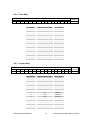
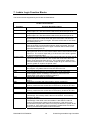
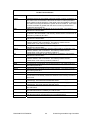
PL400 Function Blocks
Function
CMPD
ADD
ADDD
SUB
SUBD
MUL
MULD
DIV
DIVD
INC
INCD
DEC
DECD
INV
MOV
SHL
SHR
CALL
SUBR
RET
RAND
Function Block Description
Compare the 32 bit accumulator with memory(M) or with a constant(K). If
the value in the accumulator is less than the value in memory/constant
then system bit S6 is turned on. If the value in the accumulator is equal to
the value in memory/constant then system bit S7 is turned on. If the value
in the accumulator is greater than the value in memory/constant then
system bit S8 is turned on.
Add the memory(M) or constant(K) to the accumulator. The result is
stored in the accumulator.
Add the memory(M) or constant(K) to the 32 bit accumulator. The result
is stored in the accumulator. The memory used is the two consecutive 16
bit memory locations, M & M+1.
Sub the memory(M) or constant(K) from the accumulator. The result is
stored in the accumulator
Sub the memory(M) or constant(K) from the 32 bit accumulator. The
result is stored in the accumulator. The memory used is the two
consecutive 16 bit memory locations, M & M+1.
Multiply the accumulator with the memory(M) or constant(K). The result is
stored in the accumulator
Multiply the 32 bit accumulator with the memory(M) or constant(K). The
result is stored in the accumulator. The memory used is the two
consecutive 16 bit memory locations, M & M+1.
Divide the accumulator by the memory(M) or constant(K). The result is
stored in the accumulator.
Divide the 32 bit accumulator by the memory(M) or constant(K). The
result is stored in the accumulator. The memory used is the two
consecutive 16 bit memory locations, M & M+1.
Increment the memory(M). The result is stored in the memory(M)
Increment two consecutive memory(M) locations. The result is stored in
the memory M & M+1.
Decrement the memory(M). The result is stored in the memory (M).
Decrement two consecutive memory(M) locations. The result is stored in
the memory M & M+1.
Invert the bits in the accumulator
Moves a variable in a memory location to a new location. The
accumulator must already contain the address of the memory location to
be moved.
The bits in the accumulator are shifted left by the memory(M) or
constant(K). The lower bits are filled with zeros.
The bits in the accumulator are shifted right by the memory(M) or
constant(K). The upper bits are filled with zeros.
This function is used to call a subroutine. The constant(k) is the label of
the subroutine.
This function is the start of a subroutine. The constant(k) is the label of
the subroutine which is called by the call function.
This function must be placed at the last line of a subroutine. The function
can also be used in the subroutine for a conditional return.
A random number from 0 to 100 is placed in the accumulator
PROCON ELECTRONICS
20
PL400 Programmable Logic Controller