1
plasmatronics
SPS12D100 CHARGE REGULATOR
THE SPS SERIES CHARGE REGULATOR
1.
DESCRIPTION
The SPSD is designed to control the charging of batteries from photovoltaic panels and to
control the load voltage supply for voltage sensitive equipment. It is designed for use in
remote power supply systems for telecommunications or monitoring equipment.
The charge regulation and load control voltages are fully adjustable. The display is used to
show battery voltage, load voltage, solar array voltage, charge current and load current.
On the charge side, two stage boost/float regulation is used. The regulation voltages are
adjustable via the keypad and display. Up to four stage bank switching can be used which
allows taper charging in the boost mode and low speed switching regulation in the float
mode. Coupled with controlled rise and fall time switching, this allows the regulator to
achieve very low levels of audio and radio frequency emissions. These low levels of
interference make the unit particularly well suited to operation of telecommunication
equipment in weak signal areas.
A Temperature sensor may be added to compensate for changes in battery temperature.
The load disconnect feature forces load disconnection when the battery voltage is too low or
too high. The low and high disconnect voltages are adjustable. A load of up to 50 amps can
be drawn.
The control board uses a microcontroller integrated circuit coupled with a 16 x 2 line liquid
crystal alphanumeric display and a 12 key membrane switch keypad. The display and
indicators will automatically turn off after 10 minutes if no key has been pressed. Set up data
is stored in non-volatile EEPROM. To protect against program loops or errors, a hardware
watchdog timer is used to automatically force a processor reset if an error should occur.
The use of a microcontroller allows the unit to collect statistics on the performance of the
power supply system. It logs daily charge and discharge amp hours and battery maximum
and minimum voltages for 32 days. This makes system performance assessment easier.
For adjustment, a sealed membrane keypad is used rather than a set of switches and
potentiometers. This eliminates the need for elaborate sealing against high humidity and the
risk of settings drifting.
A comprehensive set of alarms is provided. Seven user definable alarm inputs are provided
as well as the internally generated alarms. Six of these are available via voltage-free relay
contact pairs.
For more accurate remote control and monitoring, a serial port is available. This allows
remote examination of the performance of the system and adjustment of the operating
parameters if necessary. It can help reduce the need for high cost field trips into areas
where access is difficult. The serial port can be connected to a modem so that the unit may
be dialed up over the switched telephone network. Both RS232 and RS485 ports are
provided. The serial port is DC isolated to make connection to other equipment easier.
Simple modular construction allows field repair to be done in a short period by changing
over modules. Two special test modes can be enabled to help in rapid testing of the unit.
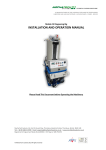
The unit is designed to be housed in a cabinet 500H x 400W x 210D mm which is sealed to
IP66 standard. The circuit boards have a conformal coating applied and the aluminium parts
are either anodised or powder coated. Circuit breakers are provided to protect the batteries
against fault conditions.
This version of the regulator is positive ground. That is, it switches on the negative side.
Plasmatronics
P12D100B-V1
Page 3 of 17