1
Physics 111 BSC Laboratory
Lab 11 Signal Processing and Control
Filtering
Filtering is best used for real-time signals 2 and can be implemented in analog or digital (software).
Analog filters can be quite simple, can work quite well, and are often sufficient. But sharp analog
filters are very complicated, and most analog filters cannot be tuned; i.e. their rolloff frequencies
cannot be changed without physically replacing components. 3 There are some applications that demand analog filters, for instance:
• Anti-aliasing. You must attenuate the frequencies above the Nyquist frequency before the signal has been digitized.
• Amplifier chains. It is not uncommon for noise to swamp the later amplifiers in the a
high gain amplifier chain. 4 If, for instance, you have a 1μ V signal masked by
100μ V noise, and you use an amplifier chain with a gain of one million, the noise
would be amplified to 100V , saturating the final amplifier which is unlikely to be
able to output much more than ±10V . You would not be able to detect your now
1V signal. However, if you use a filter early in your amplifier chain, you can get rid
of most of the noise, and prevent it from saturating the chain.
In applications where analog filtering is not required, digital filtering is often superior. Digital filters are far more flexible, can be made arbitrarily sharp, are trivially tunable, and their topology
(RC, Butterworth, Chebyshev, Bessel, etc.) is easily changeable. However digital filters are computationally intensive, and their use is limited to relatively low frequencies. Moreover, digital filters
necessarily operate on digitized waveforms, and are subject to all of the limitations (Nyquist theorem, quantization) of the digitization process.
Digital filters are difficult to design. Fortunately, there are many canned routines available, including an extensive suite in LabVIEW. We need not worry too much about the differences between the
types of digital filters; refer to Chapter 3 of the LabVIEW Analysis Concepts manual for more information. In particular, Figure 3.25 of this reference shows a handy flowchart for picking the correct
filter type.
Fourier Transforms
Fourier transforms find the spectral content of a signal: the amplitude and phase of the signal as a
function of frequency. You are all familiar with Fourier series from your math and physics classes;
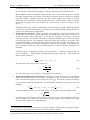
Fourier transforms are quite similar. In a Fourier series, you consider only the harmonics of the periodic wave of period T that you are analyzing:
T
⎛ 2π n ⎞
An = ∫ f (t ) sin ⎜
t ⎟ dt
⎝ T ⎠
0
In taking the Fourier transform, you analyze all times and all frequencies:
F (ω ) =
∞
∫
f (t )e − jω t dt
−∞
The Fourier transform of a sinusoid is a delta function centered at the frequency of the sinusoid.
2
Real-time signals are those which you receive as in infinite train of periodic samples, and which
you wish to analyze as your receive each sample. Other techniques, like Fourier Transforms, can be
better when you receive your entire sample before you begin processing.
3 Tunable filtering can be achieved by multiplying an incoming signal, at frequency f , by a variable
frequency sine wave at frequency f 0 . The beat frequency at f − f 0 is then passed through a sharp,
fixed frequency filter. The filter is tuned by changing f 0 . This common technique is called superheterodyning, and is used in most radios and TVs. See http://en.wikipedia.org/wiki/Superhet
4 A series of amplifiers in which each amplifier is fed by the output by the previous amplifier in the
chain.
Last Revision: August 2007
Page 3 of 17
©2007 Copyrighted by the Regents of the University of California. All rights reserved.