1
262 CHAPTER 17. TREATMENT OF SOLVATION EFFECTS WITH COSMO
referred to as PTE, performs a normal MP2 energy calculation on the solvated HF
wave function. The response of the solvent, also called reaction field, is still on the
HF level. It is the only of the three approaches that is formally consistent in the
sense of second-order perturbation theory [173,174]. In the so-called PTD approach
the vacuum MP2 density is used to calculate the reaction field. The third approach,
often called PTED, is iterative so that the reaction field reflects the density of the
first-order wave function. In contrast to the PTE approach the reaction field, i.e.
the screening charges, change during the iterations until self consistency is reached.
Gradients are available on the formally consistent PTE level only [175].
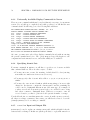
Vertical excitations and Polarizabilities for TDDFT, TDA and RPA: The
escf program accounts for the Cosmo contribution to the excitation energies and
polarizabilities. The Cosmo settings have to be defined for the underlying Cosmo
dscf or ridft calculation. In case of the excitation energies the solvent response will
be divided into the so-called slow and fast term [171, 176]. The screening function
of the fast term depends on the refractive index of the solvent which can be defined
in the input. If only the Cosmo influence on the ground state should be taken into
account we recommend to perform a normal Cosmo calculation (dscf or ridft)
and to switch off Cosmo (i.e. deactivate $cosmo) before the escf calculation.
The Direct COSMO-RS method (DCOSMO-RS): In order to go beyond the
pure electrostatic model a self consistent implementation of the COSMO-RS model
the so-called ”Direct COSMO-RS” (DCOSMO-RS) [177] has been implemented in
ridft and dscf.
COSMO-RS (COSMO for Real Solvents) [178, 179] is a predictive method for the
calculation of thermodynamic properties of fluids that uses a statistical thermodynamics approach based on the results of COSMO SCF calculations for molecules
embedded in an electric conductor, i.e. using f (ε) = 1. The liquid can be imagined
as a dense packing of molecules in the perfect conductor (the reference state). For
the statistical thermodynamic procedure this system is broken down to an ensemble
of pair wise interacting surface segments. The interactions can be expressed in terms
of surface descriptors. e.g. the screening charge per segment area (σt = qt /at ). Using
the information about the surface polarity σ and the interaction energy functional,
one can obtain the so-called σ-potential (µS (σ; T )). This function gives a measure
for the affinity of the system S to a surface of polarity σ. The system S might be a
mixture or a pure solvent at a given temperature T . Because the parabolic part of
the potential can be described well by the Cosmo model, we substract this portion
form the COSMO-RS potential:
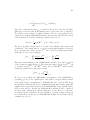
µ̃S (σ; T ) = µS (σ; T ) − (1 − f (ε))c0 σ 2 .
The parameter c0 can be obtained from the curvature of a COSMO-RS σ-potential
of a nonpolar substance, e.g. hexane. Thus, the remaining part of the chemical
potential of a compound i with mole fraction xi in the mixture Si can be expressed
as: