1
use-case Open the door: Somebody wants to open the door and
holds the transponder key close to the sensor. If the key is recognized as
being valid, the LED is switched on and the lock is released. As long as
the key remains close to the sensor and additionally 3 seconds after the
key is removed from the sensor the door remains unlocked. When these
3 seconds elapse, the door is locked again and the LED is switched o.
use-case Introduce a key to the lock-system: The code-switch is
set to a number, under which a key should be remembered by the locksystem. This number selects a table-entry to be worked upon. When the
learn button is clicked, the system enters a learn mode, which is signaled
by slow blinking of the LED. Within the learn time of 2 minutes a key
may be hold close to the sensor. If the key is recognized and not yet
included elsewhere in the table, it is accepted as a valid key for this lock
and stored in the selected entry. The learn mode is stopped and the LED
is switched o, if a key is recognized or if 2 minutes have elapsed.
Figure 2: two use-cases
After discussions on CRC-cards reach some stability, object- and classdiagrams are drawn, and the so-called reactive objects are identied. Reactive
objects are instances of reactive classes and are triggered by input signals and
produce synchronously output signals. Usually peripheral objects are reactive.
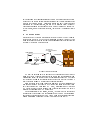
In the object diagram of gure 3 reactive objects are bold. Signals exchanged
between reactive objects and environment are identied. Often diagrams similar to timeline or message sequence diagrams are drawn to clarify this aspect.
Reactive objects are described in reactive classes. Reactive classes dene
the input and output signals, called the reactive interface, and the reactive
behavior, given either in a graphical Statechart-like notation or in a textual
Esterel-like notation, see gure 4. Also the access operations (member functions, methods, features) for both reactive and non-reactive classes are specied.
For a reactive class access operations are all private, they can be called only
from the reactive behavior. For a data-class the access operations make up the
data interface for its clients as usual.
Now access operations may be implemented and simulations can be done.
Formal verication is used to prove properties of the system, particularly to
validate design decisions and explore design alternatives. An essential feature
is that verication is done on the implemented reactive and datatype behaviors
and not on a separate model, see section 4. It is checked where dynamic binding
{as needed for a powerful object-oriented architecture{ can be implemented by
static binding for optimization. Cross-compilers are then used to generate code
for standard micro-controllers used in industry.
The behavior composed out of the reactive behavior of all reactive objects
is used to analyze real-time constraints. The maximal time consumed for reactions in all state transitions is computed to guarantee hard real-time requirements. In the RFIlock worst case reaction must be less than 1=10000 sec. This