1
The
ENV
envelope
analysis
represents a method that not only
excellently indicates bearing defects
but, followed by the FFT analysis, it
also determines which part of the
bearing is defective (inner or outer
ring, rolling element, retainer). The
analyser enables to measure TRUERMS and TRUE-PEAK values, time
signal. The envelope spectrum is
evaluated in 0-400 Hz range.
Remember, that it represents
periodicity of bearing failure. The
spectrum frequency range is in no
relation with ENV 5-16 kHz filter.
The Crest factor is a very sensitive
measurement parameter in case of
bearing mechanical damages, which
are detected already in a very early
stage. This method is fully
independent on the bearing type
and on the shaft speed.
The Kurtosis factor represents,
compared to other methods of
bearing condition analysis, a statistic
method.
Diagnostics
Defects:
of
Mechanical
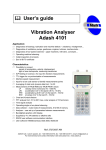
The Adash 4101 analyser is
completed with all necessary tools
for the diagnostics of mechanical
machine defects. It enables a timely
detection
of
unbalance
and
misalignment, looseness, cavitation
and resonance problems. These
basic defects along with bearing
failures represent the absolute
majority of operating problems. The
analyser is completed with efficient
methods of signal processing so that
each type of defect may be verified
in several ways, which ensures a
high reliability of detection.
The analyser enables to measure
TRUE-RMS
and
TRUE-PEAK
values, time signal and the signal
spectrum of velocity in frequency
band LF and that of acceleration in
frequency band LIN (vide the
Technical Specification on the final
page).
An efficient method is the order
analysis, providing an array of
amplitude and phase values in
speed frequency and its harmonics.
In the selection menu is first
selected the requested function and
validate by pressing the Enter key.
Operating Balancing:
Signal Path Selection:
The operating balancing is the best
manner of machine balancing. It is
not necessary to disassemble the
rotor, the whole machine being
balanced in such conditions under
which it is going to work. The Adash
4101 analysers represent an optimal
combination of characteristics since
they enable the diagnostics of
operating failures after the removal
of which the final machine balancing
is carried out. The balancing module
allows to perform single or two plane
machine balancing, without having
to use a test mass. A special wizard
leads the user through the whole
process of balancing. The module
includes software for the calculation
of mass division (e.g. on ventilator
blades).
The analyser, prior to starting
measurement, offers the user to
select one of four signal paths (vide
the Technical Specification on the
final page).
For the diagnostics of bearing
condition, mainly HF, ENV and LIN
paths are used; for the diagnostics
of mechanical failures mainly LF and
LIN paths are used.
Signal Static Parameters:
For each signal path four most
important static parameters can be
evaluated
from
a
single
measurement: TRUE-RMS and
TRUE-PEAK values and Crest and
Kurtosis factors.
Analyser control:
The instrument is controlled by
selecting menus that appear on the
display. From the analyser main
menu is activated the requested
function by pressing the relative
button.
Time Signal and Signal Spectrum:
The displayed time signal and signal
spectrum can be moved on the
analyser screen, its appropriate
resolution in both the measured
coordinates can be selected and the
cursor can be set to the requested
signal point or spectrum line.
Coordinates on the cursor position
can immediately be read from the
screen. If measurement is externally
synchronized, for instance by
tachoprobe impulses, the final
spectrum will be complex.
ADASH Ltd., Ostrava, Czech Republic, tel.: +420 596 232 670, fax: +420 596 232 671, email: info@adash.cz
For further technical and contact information consult www.adash.net, www.adash.cz