1
 Data sheet
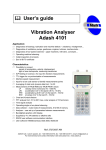
Adash 4101 vibration analysers
Application:
Diagnostics of bearings, lubrication and mechanical defects of machines – unbalance, misalignment…
Diagnostics of ventilators, pumps, gearboxes, engines, turbines, machine tools…
Diagnostics of low-speed machines – paper machines, rolling mills, transport mechanisms…
Operating machine balancing
Check-out of products
Eex ib IIB T3 certificate
Characteristics:
A possibility to connect
acceleration, velocity sensors
an optical phase probe, a measuring transformer
ICP feeding of the connected sensor, AC input for general measurement
TTL trigger for the synchronization of measurement, machine speed
measurement
Averaging of static and dynamic data measurement maximum 64
Measurement of TRUE-RMS and TRUE-PEAK values, Crest and Kurtosis
factors LF
velocity in mm/s in band 10 to 1000 Hz
2
LIN
acceleration in m/s in band 0.8 Hz to 16 kHz
2
HF
acceleration in g (9.81 m/s ) in band 5 to 16 kHz
2
ENV
envelope in m/s in band 5 to 16 kHz
FFT analysis 101 to 801 lines, order analysis of 10 harmonics
Time signal analysis
Operating single or two plane balancing
Data collector – route mode of measurement, data memory 512 kB
Analyser – user setting of parameters between measurements
Backlighted graphic LCD display
Power supply 4 x AA batteries or alkaline cells
RS 232 interface for communication with the user software
User software A4000 Download, DDS 2000, MDS 5.00
Introduction:
The Adash 4101 instrument is a
portable, fully digital data collector
and vibration analyser with the
possibility of on-line and route
measurements. It is intended for
identification of bearing condition,
lubrication and mechanical defects
of the whole machine. It enables to
apply diagnostics at the level of
measurement overall values, FFT
analyses
and
time
signal
measurement.
Its
equipment
enables not only detection of
occurring defects but also their
detailed analysis and precise
specification. It can also be used for
single and two plane machine
balancing.
The
analyser
is
characteristic by its very easy
operation. If used with the DDS
2000 database and expert system, it
is suitable for both experienced
users and beginners. Also is
possible
to
use
simple
A4000Download software. If used
with the MDS 5.00 user software, it
enables to evaluation the machine
deflection shapes.
Diagnostics
Lubrication:
of
Bearings
and
For this diagnostics, the Adash 4101
instrument offers HFE methods,
envelope analysis and Crest and
Kurtosis factor measurement.
The
measurement
of
HFE
parameter is the basic method for
the analysis of antifriction bearings.
It is based on the fact that, in case
of an incipient defect, the emitted
energy of vibrations increases in
higher frequencies (kHz levels). This
parameter is also very sensitive to
lubrication failures. The analyser
enables to measure TRUE-RMS
and TRUE-PEAK values, time signal
and signal spectrum in frequency
bands HF and LIN (vide the
Technical Specification on the final
page).
ADASH Ltd., Ostrava, Czech Republic, tel.: +420 596 232 670, fax: +420 596 232 671, email: info@adash.cz
For further technical and contact information consult www.adash.net, www.adash.cz
The
ENV
envelope
analysis
represents a method that not only
excellently indicates bearing defects
but, followed by the FFT analysis, it
also determines which part of the
bearing is defective (inner or outer
ring, rolling element, retainer). The
analyser enables to measure TRUERMS and TRUE-PEAK values, time
signal. The envelope spectrum is
evaluated in 0-400 Hz range.
Remember, that it represents
periodicity of bearing failure. The
spectrum frequency range is in no
relation with ENV 5-16 kHz filter.
The Crest factor is a very sensitive
measurement parameter in case of
bearing mechanical damages, which
are detected already in a very early
stage. This method is fully
independent on the bearing type
and on the shaft speed.
The Kurtosis factor represents,
compared to other methods of
bearing condition analysis, a statistic
method.
Diagnostics
Defects:
of
Mechanical
The Adash 4101 analyser is
completed with all necessary tools
for the diagnostics of mechanical
machine defects. It enables a timely
detection
of
unbalance
and
misalignment, looseness, cavitation
and resonance problems. These
basic defects along with bearing
failures represent the absolute
majority of operating problems. The
analyser is completed with efficient
methods of signal processing so that
each type of defect may be verified
in several ways, which ensures a
high reliability of detection.
The analyser enables to measure
TRUE-RMS
and
TRUE-PEAK
values, time signal and the signal
spectrum of velocity in frequency
band LF and that of acceleration in
frequency band LIN (vide the
Technical Specification on the final
page).
An efficient method is the order
analysis, providing an array of
amplitude and phase values in
speed frequency and its harmonics.
In the selection menu is first
selected the requested function and
validate by pressing the Enter key.
Operating Balancing:
Signal Path Selection:
The operating balancing is the best
manner of machine balancing. It is
not necessary to disassemble the
rotor, the whole machine being
balanced in such conditions under
which it is going to work. The Adash
4101 analysers represent an optimal
combination of characteristics since
they enable the diagnostics of
operating failures after the removal
of which the final machine balancing
is carried out. The balancing module
allows to perform single or two plane
machine balancing, without having
to use a test mass. A special wizard
leads the user through the whole
process of balancing. The module
includes software for the calculation
of mass division (e.g. on ventilator
blades).
The analyser, prior to starting
measurement, offers the user to
select one of four signal paths (vide
the Technical Specification on the
final page).
For the diagnostics of bearing
condition, mainly HF, ENV and LIN
paths are used; for the diagnostics
of mechanical failures mainly LF and
LIN paths are used.
Signal Static Parameters:
For each signal path four most
important static parameters can be
evaluated
from
a
single
measurement: TRUE-RMS and
TRUE-PEAK values and Crest and
Kurtosis factors.
Analyser control:
The instrument is controlled by
selecting menus that appear on the
display. From the analyser main
menu is activated the requested
function by pressing the relative
button.
Time Signal and Signal Spectrum:
The displayed time signal and signal
spectrum can be moved on the
analyser screen, its appropriate
resolution in both the measured
coordinates can be selected and the
cursor can be set to the requested
signal point or spectrum line.
Coordinates on the cursor position
can immediately be read from the
screen. If measurement is externally
synchronized, for instance by
tachoprobe impulses, the final
spectrum will be complex.
ADASH Ltd., Ostrava, Czech Republic, tel.: +420 596 232 670, fax: +420 596 232 671, email: info@adash.cz
For further technical and contact information consult www.adash.net, www.adash.cz
The process of balancing can be
suspended any time. The performed
measurements and calculations
remain stored in the analyser
memory also after it is switched off.
After switching the analyser on
again, the process of balancing will
continue from the place where it was
suspended for the last time.
Each machine item consists of a list
of measuring points.
Each measuring point item consists
of a list of measurements, required
in the measuring point of the
selected machine.
Order Analysis:
The measurement results are, like in
case of the complex spectrum,
presented to the array of amplitudes
and phases, but measured at the
speed frequency and its harmonics.
Storing of Results:
If the measurement result appears
on the analyser screen, measured
data may be stored in the instrument
memory. Measurement results thus
stored can be exported via the RS
232 serial interface from the
instrument memory to the database
of the Adash DDS 2000 expert
system, where they are archived
and available for comfort analyses.
If the processing of measurement
results is sufficient in a text format,
data can be exported from the
instrument memory using a simpler
program Adash 4000 DL.
Machine Balancing:
The single or two plane operating
balancing of machines is possible.
Prior to any balancing, on-line
measurement can be carried out to
machine stability condition check.
Models of Adash 4101:
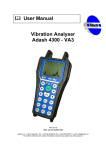
The Adash 4101 is producet in
several
types
with
different
configurations. The construction of
the Adash 4101 allows a change of
configuration only by change of
internal software (upgrade). The
basic Adash 4101 types are: BASE,
TREND and PRO.
Machine Speed Measurement:
After connecting a tachoprobe, the
machine speed in CPS and RPM
can be measured on-line.
Within the route measurement,
individual measurements or the
whole set of measurements within
the selected measuring point can be
started. The measured data are
immediately stored in the analyser
memory and later exported, via the
serial interface, to the DDS 2000
system database.
Route Measurements:
Using the DDS 2000 database
system,
a
list
of
route
measurements can be created and
transferred, any time via the RS 232
serial interface, to the analyser
memory, including the referential
values of individual measurements.
The list of route measurements has
three levels.
The
highest
level
of
route
measurements is the machine item.
Adash 4101 BASE Model:
It enables to perform basic vibrodiagnostic measurements, based on
velocity measurement, with the aim
of detecting machine defects, such
as
unbalance,
misalignment,
looseness, resonance. To detect
bearing and gear condition, the
instrument is completed with the
HFE parameter measurement. Also
this basic version is a fully
professional version with an external
sensor and its magnetic clamp for
the elimination of subjective manual
thrust, which ensures a serious
repeatability
of
all
the
ADASH Ltd., Ostrava, Czech Republic, tel.: +420 596 232 670, fax: +420 596 232 671, email: info@adash.cz
For further technical and contact information consult www.adash.net, www.adash.cz
measurements
unlike
manual
probes (so-called vibration pens).
The instrument enables to measure
TRUE-RMS
and
TRUE-PEAK
values, Crest factor and time signal
in bands LF, LIN and HF (see below
to the Technical Specification). The
instrument works in the analyser
mode and does not enable to store
the measured data for further
processing by the user software.
This instrument is suitable for
beginers and for maintanance staff.
Adash 4101 TREND Model:
It has all the characteristics of the
4101 BASE model, being further
completed with a memory for route
and on-line measurements. Only
static data (RMS, PEAK, Crest,
speed) can be stored, time signal
cannot be stored. In addition, this
instrument includes the envelope
analysis module. It works in the
analyser and data collector modes
and, if used with the DDS 2000
TREND user software, it enables to
process measurement trends, to
create route measurements and to
process certificates and reports. If
the processing of on-line measured
data is sufficient in a text format, the
simple A4000 DL user software can
be used.
The instrument can also be
completed with machine speed
measurement, order analysis and
the module of single and two plane
balancing. Signal spectrum cannot
be measured, with the exception of
balancing spectrum. The instrument
enables to trigger measurement by
an external signal or tachoprobe
impulses.
Adash 4101 Trend represents the
base instrument for standard route
vitration diagnostic.
Adash 4101 PRO Model:
It is the most efficient model
among the Adash 4101 vibration
analysers.
Besides
the
possibilities of the 4101 TREND
model, including all expansions,
it also enables to measure the
Kurtosis factor and signal
spectrum via all four LF, HF, LIN
and ENV signal paths. All types
of dynamic data (time signal,
signal spectrum, order analysis)
can be stored in the analyser
memory.
Technical Specification:
INPUT for vibration sensor (ICP power supply) or for AC input ± 3 V
TRIG for trigger impulses, machine speed (3 - 5 V)
RS 232 for optical tachoprobe, connector of communication interface with the user software
Interface:
RS 232 for communication with the user software
Sensor:
accelerometer with ICP power supply, nominal sensitivity 10, 50, 100, 500 mV/g or user setting
2
Signal ranges: 0.01 – 300 m/s (sensor 100 mV/g)
2
0.1 – 3,000 m/s (sensor 10 mV/g)
Signal paths:
LF
velocity in mm/s in band 10 to 1,000 Hz, signal integrated
2
LIN
acceleration in m/s in band 0.8 Hz to 16 kHz
2
HF
acceleration in g (g = 9.81 m/s ) in band 5 to 16 kHz
2
ENV
acceleration in m/s in band 5 to 16 kHz, signal envelope modulated
Balancing:
velocity in mm/s in band 10 to 200 Hz (600 to 12,000 RPM), signal integrated
Measured data: values TRUE-RMS, TRUE-PEAK, Crest and Kurtosis factors, machine speed
measurement of time signal, signal spectrum and order analysis
operating single and two plane machine balancing
Averaging:
maximum 64
Trigger:
auto (internal), manually (key), external signal
Display:
backlighted graphic LCD
Data memory: 512 kB
Power supply: 4 x alkaline cells 1.5 V or accumulators 1.2 V (AA size)
Size:
223 x 105 x 40 mm
Weight:
approx. 500 g
Inputs:
Protection:
IP 55
Order Information:
The fully equipped measuring set Adash 4101 PRO includes:
- Adash 4101 vibration analyser
- analyser user's manual
- vibration sensor
- coiled cable for connection of the vibration sensor
- magnetic clamp for the vibration sensor
- optical or laser tachoprobe
- digital scales (for balancing)
- CD-ROM with the user SW (A4000 DL, DDS 2000, MDS 5.00 – as per order)
- RS 232 serial connection cable with Canon 9 terminals for communication with the user SW
- user SW manual
- 4 x accumulators AA 1.2 V
- battery charger with user's manual
- leather protective cover for the analyser
- transport bag with a strap
ADASH Ltd., Ostrava, Czech Republic, tel.: +420 596 232 670, fax: +420 596 232 671, email: info@adash.cz
For further technical and contact information consult www.adash.net, www.adash.cz