1
Understanding and using
guidelines for vibration
Options are:
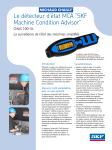
The SKF Machine Condition Advisor provides
a means to evaluate machine health based
on ISO 10816-3 and to evaluate the bearings according to general guidelines developed from a statistical analysis of existing
databases.
Alert: 2,8 mm/s (0.16 ips)
Danger: 4,5 mm/s (0.25 ips)
How to choose the correct “Alarm Velocity
Group” for your machinery
G1 and 3R
The Alarm Velocity Group (G2&4 or G1&3)
determines the instrument’s “overall vibration” alarm limits. Therefore, select the
Group that best describes the general size,
type, and speed of the machinery being
measured. Note that these machine group
classifications are set forth in ISO 10816-3,
which rates overall velocity vibration levels
for standardized machinery classifications.
Groups 2 and 4 (default)
ISO Group 2 and 4 classifications define the
following type of machinery:
• Medium-sized machines and electrical
machines with a shaft height between
160 and 315 mm (6.3 and 12.4 in.).
• These machines are normally equipped
with rolling element bearings, but may
use sleeve bearings, and operate at
speeds above 600 r/min.
• These machines include pumps with
multi-vane impellers and integrated
drivers.
Groups 1 and 3
ISO Group 1 and 3 classifications define the
following type of machinery:
• Large machinery and electrical machines
with a shaft height greater than 315 mm
(12.4 in.).
• These machines are generally equipped
with sleeve bearings, but may use rolling
element bearings.
These machines include pumps with multivane impellers and integrated drivers.
Rigid or Flexible foundation?
An additional setting allows the specification
(when defining the overall alarm levels) of
measurements taken from machinery with
Rigid (default) or Flexible foundations.
G2 and 4R (default)
G2 and 4F
Alert: 4,5 mm/s (0.25 ips)
Danger: 7,1 mm/s (0.39 ips)
Alert: 4,5 mm/s (0.25 ips)
Danger: 7,1 mm/s (0.39 ips)
Expanding your capabilities
with SKF Machine Condition
Advisor compatible
accessories
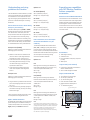
Extension sensor kit Model CMAC 105-K
The Extension sensor kit CMAC 105-K contains an accelerometer with integral cable
(CMAC 104) and magnet (CMAC 109) with
mounting stud. This kit is needed to take
measurements from hard-to-reach places
and for more repeatable and accurate measurement results.
G1 and 3F
Alert: 7,1 mm/s (0.39 ips)
Danger: 11,0 mm/s (0.61 ips)
How to choose the correct “Enveloped
Acceleration Classification” for your
machinery
The Enveloped Acceleration Classification
(CL1, CL2, or CL3) you specify determines
the instrument’s “bearing vibration” alarm
levels. Therefore, the Enveloped Acceleration
Classification that best describes the general
size and speed of the bearings being
measured should be selected.
Options are:
CL1
Accelerometer
• 100 mV/g sensitivity
• Small size case
• 0,5 to 15 000 Hz frequency response
(±3 dB)
• Waterproof
Bearings with a bearing bore diameter between 200 and 500 mm (7.9 and 19.7 in.)
and a shaft speed below 500 r/min.
Alert: 1 gE
Danger: 2 gE
Integral cable (1,5 m standard)
CL2 (default)
•
•
•
•
•
•
Bearings with a bearing bore diameter
between 50 and 300 mm (2.0 and 11.8 in.)
and a shaft speed between 500 and
1 800 r/min.
Alert: 2 gE
Danger: 4 gE
• Connector to SKF Machine Condition
Advisor CMAS 100-SL
• Various cable lengths available
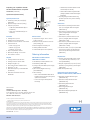
Magnet, Model CMAC 109
14 kg (30 lbs.) pull-strength
25 mm (1 in.) diameter
1/4-28 mounting hole
Case material: Stainless steel
Magnet material: Neodymium
1/4-28 Mounting Stud
1/
4-28
mounting hole
CL3
Bearings with a bearing bore diameter between 20 and 150 mm (0.8 and 5.9 in.)and
a shaft speed from 1 800 to 3 600 r/min.
Alert: 4 gE
Danger: 10 gE
Note:
As with all commonly published severity guidelines, the
above provides target thresholds for new, refurbished and
recently maintained equipment. In addition, if both lower
limits of the guideline are used (for example in CL2, a
50 mm bearing bore diameter at 500 r/min), the
applicable alarm values maybe lower. Note that bearing
bore diameter is equal to shaft height.
24,0 mm
(0.94 in.)
ø 25,0 mm (1.0 in.)
3