1
Extended Memory and Modularity Are
Added to the Series 80 Computer Family
HP's newest Series 80 computers, the HP-86 and HP-87XM,
provide memory capacities up to 640K bytes, different
combinations of built-in interfaces, and for the HP-86, a
modular system configuration.
by John T. Eaton, Andrew W. Davidson, and William R. Frolik
IN 1980, HEWLETT-PACKARD introduced the HP-85,
the first member of the Series 80 computer family.1'2 It
was designed to aid the scientist or engineer in collect
ing, analyzing, storing and displaying data. With its own
internal tape drive, printer, display, and four expansion
ports, the HP-85 provides effective portable solutions to
many data processing problems.
The Series 80 family is now expanded by two new mem
bers, the HP-86 and HP-87XM. These computers perform all
the workstation (nonportable) functions performed by the
HP-85 and many business functions not previously avail
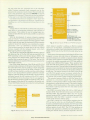
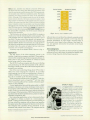
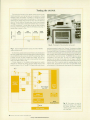
able from Series 80 products. The block diagrams of these
two new computers are basically the same, differing only in
the amount of internal memory, built-in interfaces, and
video display configuration (Fig. 1).
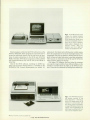
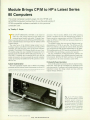
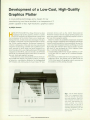
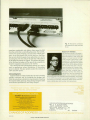
The HP-86 (Fig. 2) is designed to provide the nucleus for
the lowest-cost Series 80 workstation system. It has 64K
bytes of internal RAM, uses an external video monitor, and
has built-in interfaces for two flexible disc drives and a
printer. The design provides a low-cost computer that al
lows the user to select peripheral components from a vari
ety of sources.
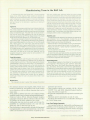
The HP-87XM (Fig. 3} was designed as the premier per
sonal computer of the Series 80 family. It has 128K bytes of
internal RAM and a built-in 80-character-by-24-line CRT
display. It uses a built-in HP-IB* interface to communicate
with external disc drives, plotters, and printers.
Both computers have four expansion ports which can be
used to enhance their capabilities. These ports are com
pletely compatible with all Series 80 I/O interfaces. ROM
and RAM modules for the HP-86 and HP-87XM are not
interchangeable with the HP-85's ROM and 16K RAM
modules. RAM modules are available in 32K, 64K, and
128K byte sizes. Up to four of these memory modules, in any
combination, can be inserted into the ports of the HP-86 to
increase its total RAM up to 576K bytes, and in the HP87XM to increase its total RAM to 640K bytes.
Software
representation of programs in these two new computers
compared to the HP-85's internal representation, the HP-86
and HP-87XM have a built-in translator to convert an HP-85
BASIC program to their internal representation after it is
loaded. The translated program can then be run or stored for
future use as an HP-86 or HP-87XM program.
Composite
Video
Output
Internal
CRT
(HP-87XM)
64K RAM
(HP-86)
or
128K RAM
(HP-87XM)
Encoder
(HP-86)
!. a .,2 S
6 5 2
i > >
System,
Mass Storage,
and Printer
ROMs
CRT
Controller
16K Display
Memory
Translator
Chip
Keyboard
Controller
and Timers
Keyboard
Microcomputer
HP-IB
Connector
(HP-87XM)
With a large number of HP-85s already in use, it is desir
able for new Series 80 computers to be compatible with
existing HP-85 BASIC language software. For this reason, a
BASIC language interpreter and operating system is pro
vided. Because there are some differences in the internal
•Hewlett-Packard Interface Bus, HP's Implementation of IEEE Standard 488 (1978).
Disc Drive (2)
and Printer
Connectors
(HP-86)
Fig. 1 . System block diagram for the HP-86 and HP-87. Other
than the differences in video output configuration, built-in inter
faces, and amount of internal memory, the two computers use
the same electronic system.
DECEMBER 1982 HEWLETT- PACKARD JOURNAL 3
© Copr. 1949-1998 Hewlett-Packard Co.