1
AT A GLANCE
criteria, evaluating the relative merits of design alternatives, balancing the trade-offs,
and optimizing a design for a set of goals are
properly left as exercises each designer must
work through in the context of an individual project, guarding all the while against
confusing the most familiar approach with
the best one.
And, as if that weren’t enough, the design
world is rarely homogeneous; more often
than not it’s a matter of one and the other, not one or the other. At minimum,
for example, OEMs involved in analog design commonly use shards of
control logic in the form of inexpensive microcontrollers or—
thanks to mixed-signal integration—small cores or even
homebrewed state-machines.
More typically, analog circuits
serve as the physical interfaces for
predominantly digital systems
(Reference 1).
Rather than representing opposing
disciplines, as they are so often miscast, the
crafts of analog and digital design have acted synergistically for decades; witness the
great success of mixed-signal ASSPs (application-specific standard products).
But despite significant strides in mixedsignal design, the analog discipline has
not, by and large, evolved to include devices
whose functions, like digital devices, are either statically or sequentially determined by
programming, not by wiring.
Analog-IC manufacturers have used the
term “programmable” in a variety of ways,
mostly in place of “adjustable.” In such cases, the term is often adjacent to a qualifier,
such as “pin” or “resistor.” Thus, programmable-gain amplifiers allow you to set the
closed-loop gain with a fixed resistor, continuously variable resistor, or a network of
fixed resistors and switches. A number of
analog-IC manufacturers sell op amps that
are bias-current-programmable with respect to gain-bandwidth product, slew rate,
and power dissipation. Others offer digitally programmable potentiometers and other
R-DAC-based cells whose behaviors vary by
a digital word acting most often on a single
parameter. These fixed
Illustration by Rob Magiera
functions, though indeed useful, do not offer the sort of functional programmability you think of when
you consider digital constructs any more advanced than simple combinatorial logic.
www.edn.com
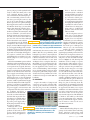
컄 The good: You can be up and running in
no time. The interface is suitably intuitive,
and the development tool includes a rudimentary simulator that can speed circuit design. The parametric ranges for most cells
are impressive, and reprogramming either
individual parameters or the entire topology on the fly is quick and easy.
컄 The bad: There is no apparent way to
simulate the product on or to export simulation data to a standard Spice tool. There is
also no way to include components external to the FPAA in its simulation. This situation is similar to that which exists in many
of the more sophisticated power ICs and
ASSPs whose manufacturers provide limited
but useful design-support software.
컄 The ugly: Not much, really. The antialiasing filter on the FPAA’s input cells can increase distortion when set near the low-frequency extreme of its tuning range, particularly with large amplitude signals. Don’t expect 16-bit noise performance from a 12- to
14-bit product. Be careful to read the evaluation board’s manual before you apply power to the board.
June 12, 2003 | edn 39