1
1. ECG and temperature monitoring
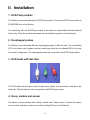
The esophageal probe labeled CAT is intended for kittens, cats, puppies, and very small
dogs, while the esophageal probe labeled DOG is suitable for dogs from small to large sizes.
In order for the probe to register high-quality ECG, all three metal rings must establish good
contacts with the esophagus. If the probe is too small for the patient, it will not be able to
establish good contacts with the esophagus. Applying the CAT probe in dogs may
produce erratic ECG.
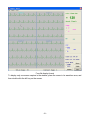
Connect the esophageal probe to the ECG/Temp module. After the patient has been
anesthetized and intubated, estimate how deep to insert by laying the probe onto the
patient. The distal ring and middle ring should be positioned across the heart after
inserted. Insert the probe into the esophagus to the depth as estimated above, and
then watch the screen. If registered ECG is erratic, i.e. ECG baseline is unstable,
adjust the position (depth) of the probe until stable ECG is registered. Motions induced
to the patient and/or probe during the procedure may produce motion artifacts on the ECG.
Tie the esophageal probe to the endotracheal probe to minimize motions if necessary.
Never insert a probe into a patient not anesthetized and intubated. Do not use a probe which
is defective or damaged externally. When using the esophageal probes in electrosurgery, the
patient must be properly grounded as instructed in the User’s Manual for the electrosurgical
unit being used.
2. Respiration monitoring
The Monitor incorporates VetSpecs® proprietary airway-direct respiration monitoring
technology, which provides real-time respiratory waveforms and RR. This technology is
suitable for cats and dogs of all sizes, and effective and reliable even when motions are
induced to the patient.
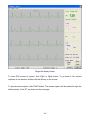
To monitor respiration during dental or surgical procedures, simply insert the Resp. sensor
between the breathing circuit and the endotracheal tube.
-5-