1
SunScan - Canopy Analysis System
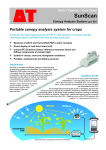
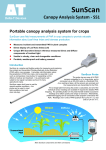
SunScan Probe and Data Collection Terminal, with SunShine Sensor mounted on tripod
SunScan System Choices SunScan is modular and expandable. This
means researchers can specify a system that suits their own performance
requirements and budget
System type
Features and Advantages
SunScan Recommended-Plus System type SS1-R3BF3
This is the complete package of SunScan items,
including SunScan Probe, SunData Software, Data
Collection Terminal, Sunshine Sensor type BF3, tripod
and carrying case
The Recommended-Plus System provides a powerful
canopy analysis tool. It can calculate instant estimates
of LAI, measure PAR interception using spot readings
or with unattended logging and measure sunflecks.
A major advantage for field use is that the BF3
Sunshine Sensor needs minimal adjustment during use
(see opposite page).
SunScan Standard System type SS1-STND2
The Standard System comprises The SunScan Probe,
SunData Software and the Data Collection Terminal
The Standard System is able to make the full range of
SunScan measurements, including LAI. However, as
the SunScan Probe has to be used as its own abovecanopy reference, it can only be used in steady light
conditions: blue sky or evenly overcast.
Entry System type SS1-ENTRY
The Entry System includes the SunScan Probe and the
SunData Software only
The lowest cost version of SunScan. The Entry System
runs on the user's portable PC instead of the Data
Collection Terminal; it has all the functionality of the
Standard System, but see "Use With a Portable PC"
opposite, for comments on the use of PCs in the field.
SunData software modelling
An advanced model of light transmission through a uniform canopy has been developed and is used in the analysis software. This
model builds on work by Campbell (1985), and Norman and Jarvis (1975), and takes account of the following factors:
• Direct & Diffuse incident light
• Solar zenith angle
• Canopy Leaf Area Index
• Canopy Leaf Angle Distribution
• Leaf PAR absorption
• Transmitted fraction
Solar zenith angle is calculated from the actual time, latitude and longitude. Estimates of canopy Leaf Angle Distribution
and Leaf Absorption are made by the user. All other variables necessary to calculate LAI are measured directly.
Because the relative contributions of Direct and Diffuse incident light are physically measured at the same time as the transmitted
PAR, readings can be made in a wider range of daylight conditions than has been possible with previous instruments. We advise
against taking measurements when the sun is strong and near the horizon, when large errors may occur.
The assumptions and calculations made in the SunData software are fully explained in the user manual, along with practical advice
on how to use the system effectively.