1
PAGE 4
DIAGENODE IDEAL CHIP-SEQ KIT FOR TRANSCRIPTION FACTORS USER MANUAL
Introduction
Association between proteins and DNA is a major mechanism in many vital cellular functions such as gene transcription
and epigenetic silencing. It is crucial to understand these interactions and the mechanisms by which they control and
guide gene regulation pathways and cellular proliferation. Chromatin immunoprecipitation (ChIP) is a technique to
analyze the association of proteins with specific genomic regions in intact cells. ChIP can be used to study changes in
epigenetic signatures, chromatin remodelling and transcription regulator recruitment to specific genomic sites.
The different steps of the ChIP assay are cell fixation (cross-linking), chromatin shearing, immunoprecipitation, reverse
cross-linking followed by DNA purification and analysis of the immunoprecipitated DNA.
In ChIP, living cells are first fixed with a reversible cross-linking agent to stabilize protein-DNA interactions. The most
widely used reagent to fix cells is formaldehyde which generates covalent bonds between amino or imino groups of
proteins and nucleic acids. Formaldehyde treatment crosslinks both DNA-protein as well as protein-protein complexes.
Following cross-linking, chromatin needs to be sheared very efficiently into homogeneous small fragments that can
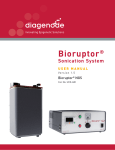
subsequently be used in immunoprecipitation (IP). The Bioruptor® shearing devices from Diagenode provide you with
high quality sheared chromatin ready-to-ChIP. Currently, the Bioruptor® is the most widely used and the most cited
chromatin fragmentation system as evidenced by more than 1000 publications. Shearing may also be accomplished
with shearing kits from Diagenode which enable an easy and highly reproducible shearing process for any cell type.
After fragmentation, the sheared chromatin is precipitated with a specific antibody (AB) directed against the protein
of interest. The chromatin-AB complex is isolated using magnetic beads. Finally, the precipitated DNA fragments are
released from the AB, and analyzed. Enrichment of specific sequences in the precipitated (IP’d) DNA indicates that
these sequences were associated with the protein of interest in vivo. Analyzis of specific regions can be performed by
quantitative polymerase chain reaction (qPCR). In recent years, ChIP combined with high-throughput Next-Generation
sequencing (ChIP-seq) has become the gold standard for whole-genome mapping of protein-DNA interactions.
Although ChIP-seq is a powerful tool, the procedure requires tedious optimization of several reaction conditions that
might lead to considerable time and lab expenditures. To reduce these tedious steps, Diagenode provides kits with
optimized reagents and protocols for ChIP which enable successful ChIP-seq. The new iDeal ChIP-seq kit protocol has
been thoroughly optimized by Diagenode for ChIP followed by high-throughput sequencing on Illumina® HiSeq.
Diagenode also offers a wide range of additional tools and products for ChIP analysis including the Bioruptor® for
chromatin shearing and nucleic acid fragmentation, the IP-Star® Compact for automated ChIP and DNA methylation
analysis, magnetic racks for 0.2 or 1.5 ml tubes which enable you to work with magnetic beads under optimal conditions
(4°C), and ChIP and ChIP-seq grade antibodies against many epigenetic targets. In addition, Diagenode provides individual
reagents, such as magnetic beads, negative IP controls (mouse and rabbit IgG), protease inhibitors and deacetylase
inhibitors (sodium butyrate). Diagenode also offers several qPCR primer pairs for the analysis of IP’d DNA. Peptides can
additionally be purchased for use in blocking experiments (negative ChIP controls).
All our products have been extensively validated in ChIP on various targets. The combination of all our quality-controlled
kits, reagents and equipment is a perfect starting point that will lead to your success.
Innovating Epigenetic Solutions