1
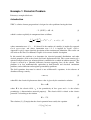
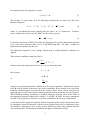
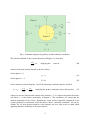
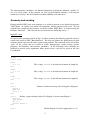
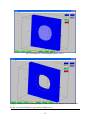
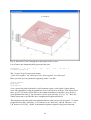
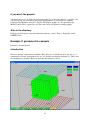
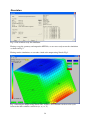
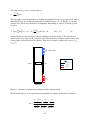
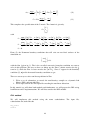
Example 1: Dielectric Problem Directory: examples/dielectric Introduction ZINC is a finite element program that is designed to solve problems having the form − ∇ . ( C ∇U ) + a U = f , (1) which is written explicitly in component form as follows − ∂ ∂xi αβ ∂U β C ij + a αβ U β = f α , α = 1, 2, ... , N ∂ x j (2) where summation over 1, 2, …. N (where N is the number of variables) is implied by repeated Greek superscripts, and where summation over 1, 2, 3 is implied by Arabic suffices. Appendix A gives a more detailed description of the notation and definitions. The reader can also refer to the Zinc User Manual, Chapter 4, for a more detailed description. In this tutorial, the problem is to determine the electrical potential distribution, and other derived properties such as the electric field and displacement field. The system consists of a spherical sample of one type of material that is embedded in a cuboid of another material. The system is excited by a potential difference between opposing faces of the cuboid. This problem is in fact mathematically equivalent to both thermal and electrical conduction problems, and to diffusion and magnetic permeability problems. The field equations that must be solved is one of Maxwell’s equations, in the absence of distributed charge, namely, ∇. D = 0 , (3) where D is the electric displacement whose value is given by the constitutive relation D = ε ε0E , (4) where E is the electric field, ε0 is the permittivity of free space and ε is the relative permittivity (a dimensionless material property). The electric field is related to the electric potential V according to the relation E = − ∇V . (5) The relations (3)-(5) imply that the electric potential must satisfy the equation − ∇. ( ε ε0∇V ) = 0 . 2 (6)