1
User Manual v1.2
CORE
& ESP BAR SYSTEM
Short manual:
CORE GT and
CORE ESP CONTROL SYSTEM
Setup Bar and flying lines
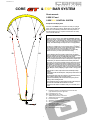
The new Core ESP Control System is ready for plug &
play. Just unwind your lines, attach them to the kite and
have fun! The following instructions and the picture on
the left should give you a quick overview how to setup
your new kite and bar.
K
PREFLIGHT CHECKLIST
D
C
C
A
A
B1
D
1. Make sure your launch is open, FREE OF DOWNWIND BYSTANDERS, hard objects, nearby power lines, buildings and walls, within
at least 200 ft. (60 m), and preferably more. Some riders have needed
in excess of 500 ft. (170 m), to regain control in violent dragging or
loftings. Avoid kiteboarding near airports and in low flight path areas, complaints have led to restricted access in some areas.
2. Check to see what size kite other kiteboarders are rigging and get
their input on conditions. Do not rig too large a kite for conditions
and carefully consider advice of more experienced riders. Failure to
act on prudent advice has cost some riders severe injury.
3. Check your kite for tears or leaky bladders. If you have leaky
bladders or tears in your kite, repair them before flying.
4. Check ALL kite, harness, control bar lines, webbing, pigtails,
bridles, the chicken loop and leaders for knots, wear or abrasions. If
the line sheathing shows any breaks, replace them. The pigtails
should be replaced no less frequently than every 6 months on inflatable kites. Inspect and test your EJECTOR quick release.
5. Make sure your flying lines are equal as they will stretch unevenly
with use. If they have knots that can´t be easily untied, replace your
flight lines.
6. Walk down your lines and examine them carefully. Just before
launch pick your bar up and carefully look down the lines for twists
and tangles that could cause the kite to be dangerously uncontrollable. While you are holding your bar up look down the lines, shake
your bar to make sure the center lines are connected to the leading
edge of the kite. Be particularly careful, slow and methodical in high
winds. Multiple, careful preflighting in higher winds is strongly advised.
Inflate the kite to a max of 6psi and close the FastPump-Clamps
properly.
To depower the kite with the adjuster , always keep a little tension on
the backlines.
B2
With the minihook the rider can fix the bar in the powered position.
This is usefull in jumps and in low wind cruising.
Beginners should allways take off the minihook rope to prevent
hooking in when starting the kite.
G
Before starting the kite you should allways check all bar safety systems and feel comfortable with all features on the bar.
Double-check the weather conditions and if you´re in doubt, don´t
go out!
A: Powerlines (black), red attachment point for left side,
grey attachment point for right side
B1: Left steering line - red
B2: Right steering line - white
C: Attachment points for power lines
D: Attachment points for steering lines
E: Pull-Pull Adjuster
F: Adjustable steering lines (inside floater)
G: 5th line with stopperball (red)
H: Variable bar widths
I: EJECTOR safety release system
J: Safetyleash with safety leash release
K: Exchangable pulley lines
E
F
F
H
I
H
J
3