1
-2-
modules process the messages in various ways.
The two end modules in a stream become connected automatically when the device is opened; intermediate modules are attached dynamically by request of the user’s program. Stream processing modules
are symmetrical; their read and write interfaces are identical.
Queues
Each stream processing module consists of a pair of queues, one for each direction. A queue comprises not only a data queue proper, but also two routines and some status information. One routine is the
put procedure, which is called by its neighbor to place messages on the data queue. The other, the service
procedure, is scheduled to execute whenever there is work for it to do. The status information includes a
pointer to the next queue downstream, various flags, and a pointer to additional state information required
by the instantiation of the queue. Queues are allocated in such a way that the routines associated with one
half of a stream module may find the queue associated with the other half. (This is used, for example, in
generating echos for terminal input.)
Message blocks
The objects passed between queues are blocks obtained from an allocator. Each contains a read
pointer, a write pointer, and a limit pointer, which specify respectively the beginning of information being
passed, its end, and a bound on the extent to which the write pointer may be increased.
The header of a block specifies its type; the most common blocks contain data. There are also control blocks of various kinds, all with the same form as data blocks and obtained from the same allocator.
For example, there are control blocks to introduce delimiters into the data stream, to pass user I/O control
requests, and to announce special conditions such as line break and carrier loss on terminal devices.
Although data blocks arrive in discrete units at the processing modules, boundaries between them are
semantically insignificant; standard subroutines may try to coalesce adjacent data blocks in the same queue.
Control blocks, however, are never coalesced.
Scheduling
Although each queue module behaves in some ways like a separate process, it is not a real process;
the system saves no state information for a queue module that is not running. In particular queue processing routines do not block when they cannot proceed, but must explicitly return control. A queue may be
enabled by mechanisms described below. When a queue becomes enabled, the system will, as soon as convenient, call its service procedure entry, which removes successive blocks from the associated data queue,
processes them, and places them on the next queue by calling its put procedure. When there are no more
blocks to process, or when the next queue becomes full, the service procedure returns to the system. Any
special state information must be saved explicitly.
Standard routines make enabling of queue modules largely automatic. For example, the routine that
puts a block on a queue enables the queue service routine if the queue was empty.
Flow Control
Associated with each queue is a pair of numbers used for flow control. A high-water mark limits the
amount of data that may be outstanding in the queue; by convention, modules do not place data on a queue
above its limit. A low-water mark is used for scheduling in this way: when a queue has exceeded its highwater mark, a flag is set. Then, when the routine that takes blocks from a data queue notices that this flag is
set and that the queue has dropped below the low-water mark, the queue upstream of this one is enabled.
Simple Examples
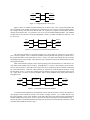
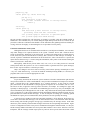
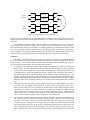
Figure 1 depicts a stream device that has just been opened. The top-level routines, drawn as a pair of
half-open rectangles on the left, are invoked by users’ read and write calls. The writer routine sends messages to the device driver shown on the right. Data arriving from the device is composed into messages
sent to the top-level reader routine, which returns the data to the user process when it executes read.