1
Application Note 038
3
3.1
Wake-on-Radio (WOR)
WOR priciples
For many battery operated (point-to-point) communication systems without the need of
constant throughput, but with strict demands of power-efficiency, the simple configuration with
an “always-on” receiver and an infrequently transmitting station will in most cases not fulfill
the desired power budget. By using the principle of receive mode (RX) polling, the reduction
of the RX duty cycle obtained makes low-power applications feasible, especially in
asymmetric systems where all units do not have equal requirements for low power
consumption. In addition, to minimize the power consumption, it is a good idea to put the
radio in a power-saving sleep state in between the RX polling periods by disabling all
functionality that is not necessary at that time.
The advantage with WOR is that the RX polling is fully automated by the radio and there is no
need for the microcontroller (MCU) to interfere (strobe RX commands). This means that also
the MCU can stay in power-down mode and further save power while waiting for a packet.
The MCU will only have to wake up when the radio actually detects a packet – it only has to
Wake-on-Radio activity. This is the reason WOR is a useful feature for power-saving
applications.
3.2
WOR and CC1100/CC2500
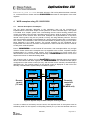
The Wake-on-Radio functionality of CC1100/CC2500 enables it to stay in a power-saving
SLEEP state and periodically wake up from deep sleep and listen for incoming packets in RX
without microcontroller interaction. The programmable wake-up period is controlled by a
WOR timer, run by an internal RC oscillator. This implies that the RC oscillator must be
enabled before the WOR strobe command can be used.
The radio’s configurable GDO pins are used to signal the interrupts intended for the MCU on
the desired event. For instance, if a sync word is detected during the RX period, the
CC1100/CC2500 can trigger an interrupt to wake up the MCU. The MCU can then make a
decision on what to do next; e.g. switch to TX and send an ACK or, if the CRC of the received
packet failed, continue in WOR mode (go back to SLEEP). In the latter case, after a packet
has been received, the radio will always go to the IDLE state. That means that if it is desirable
to continue in WOR mode, the MCU manually has to strobe another WOR command on the
SPI.
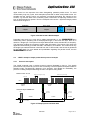
If no sync word is detected while in RX, a programmable RX timeout will make the chip
automatically return to sleep mode and continue in WOR mode without interrupting the MCU.
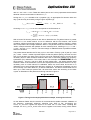
The Wake-on-Radio functionality may also be used in combination with CC1100/CC2500 ’s
RX_TIME_RSSI function. This function will perform an initial RSSI level measurement when
entering RX mode, and if the RSSI value does not exceed a programmable threshold, the RX
will terminate immediately and return to SLEEP – still in WOR mode. This function can reduce
the time in RX and contribute to lower power consumption if no signal is present.
The CC1100 offers two different methods of using WOR – with or without the automatic
synchronization feature, while CC2500 offers only WOR without autosync. This application
note will only look at WOR applications not using autosync.
SWRA055
Page 3 of 14