1
Increase in any of these factors will therefore increase the size of the signal which is
generated.
It is important to note that most Clark-type electrodes require the water to be stirred. Only
in a microcathode electrode, fitted with a low permeability membrane, is stirring not
required.
2.2
Principle of the 1302 Microcathode Electrode
The 1302 is a precision electrode with a very small diameter microcathode. Because of
this, the rate of consumption of oxygen is extremely low, so that when used with the
relatively low permeability polypropylene membranes, most of the resulting oxygen gradient
is confined to the distance between the outside of the membrane and the cathode
surface.Consequently there is no requirement for physical movement of the solution to
replenish the oxygen at the outer surface of the membrane. There is a very small stirring
effect, which would result in an error of 2 - 3% if the electrode has been calibrated in stirred
solution and used in unstirred solution, and vice versa.
When used with fast-responding highly permeable FEP membranes, the flux of oxygen
through the membrane is increased. In this case, the electrode behaves like a
macrocathode electrode and it is then necessary to stir the solution. Regrettably, it is not
possible to build an electrode with a fast response time but no stirring requirement.
2.3
Electrode Construction
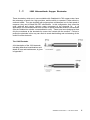
The electrode consists of a glass tube containing a 20µ platinum wire whose exposed tip
forms the cathode. A band of silver is wrapped around the glass a few centimetres behind
the tip, which, when chlorided, forms the anode. Electrical connection between the anode
and cathode is via an electrolyte of buffered KCl solution. The electrolyte is contained
within a jacket over whose tip is stretched a thin polypropylene membrane which is kept
taut by an 'O' ring. When assembled, the membrane makes a tight fit over the glass tip.
The jacket is unscrewed from the body of the electrode in order to replace the membrane
or electrolyte. A standard jacket is used with standard polypropylene membranes but
when using fast responding FEP membranes, it is necessary to use a jacket with a very
fine pressure relief hole. If a standard jacket is used with FEP membranes, the hydrostatic
pressure produced as the jacket is tightened on the thread will cause the membrane to lift
away from the cathode, thereby increasing the O2 diffusion path and response time of the
electrode.
2.4
Fitting the membrane
The electrode is normally tested and electrolyte solution added before shipping. However,
if storing the electrode for a long period of time we recommend storing it dry to prolong the
life of the electrode.
Unscrew the electrode jacket and lay the electrode carefully on a paper tissue on a safe
part of the bench. It is very vulnerable to damage when the jacket has been removed.
Pour off the electrolyte and carefully prise off the retaining 'O' ring with the points of fine
forceps. Rinse the electrode and jacket with distilled water and blot them dry with soft
paper tissue. Stand the electrode jacket with its broad end on the bench. Now take an 'O'
Strathkelvin Instruments } 929 User's Guide
50