1
ThiMeT : Thickness Measurement Tools for SRIM
www. ThiMeT.org
Now you are ready to use ThiMeT. For the same material and ion you don’t need to do same steps
given above but if you want to calculate for new material or for new projectile, you should follow
again steps 1 to 7.
In order to run ThiMeT code just double clicks to “ThiMeT.exe” file or in command mode type
“ThiMeT.exe”. Code will ask you just two parameter, “Projectile energy” and “Exit energy” from the
material. Please give energies as integer and in “keV” unit. Code will calculate thickness in a few
seconds, according to energy difference between incident ions and exit ions may be it takes longer.
Thickness results are in two units; μm (micron) and μg/cm2 or mm and mg/cm2 according to its
value.
Verification
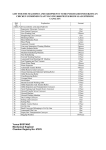
Here you can find some example calculation and result for common degrader materials in order to
verify your results. SRIM-2013 stopping power (SR Module) values were used for these calculations.
Table 1. ThiMeT thickness calculation for common degrader materials.
Projectile
H
H
H
H
He
He
He
He
He
Target /
Degrader
Material
Be
C
Al
Plexiglas
Be
C
Al
Al
Al
Incident ion energy
(keV)
Exit ion energy
(keV)
100 000
100 000
100 000
158 600
100 000
100 000
100 000
10 000
3 183
88 488
84 344
83 628
30 000
86 002
80 947
80 947
8 000
1 000
ThiMeT Thickness
9.9953 mm
9.9921 mm
9.9950 mm
144.8785 mm
999.418 μm
999.382 μm
999.632 μm
17.899 μm
8.377 μm
Limitations
Some SRIM stopping power and experimental one, not in a good agreement for all energy ranges, ions
and targets. Please check related energy range from SRIM web site (www.srim.org)
You can use 1 keV to 1 GeV energy range, but please consider that for low energies, deviation on SRIM
stopping power is too high. You can check stopping power deviation for related energy range from
SRIM web site. It is better to double check your results with TRIM (the Transport of Ions in Matter)
simulation. It means, enter your thickness result from ThiMeT to TRIM, and check energy loss
calculated from TRIM (www.srim.org). For average energy loss calculation you can use TTEC code.
For more information of reliability of stopping power codes and tables, see these references; [9-26].
3