1
current goal. This is an especially serious problem when we
consider scaling up such planners. Useful intelligent agents
will probably have to deal with a range of different problems, and will have at their disposal a range of different actions. Only a small subset of these actions are likely to be
relevant to any particular task. If a forward chaining planner
has to explore all possible actions irrespective of the goal,
then it is ultimately doomed to failure. The algorithms we
develop here address this problem, and doing so we demonstrate that this particular argument against forward chaining
planners can be countered.
Of course there are other arguments against forward
chaining planners that still remain. Most importantly among
these is the issue of totally vs. partially ordered action sequences. The fact that forward chaining planners explore totally ordered action sequences remains an area of difficulty
for such planners. We do not address this issue here, but we
are currently exploring some mechanisms for dealing with
this problem also.
The overall aim of this and other work we are pursuing is
to try to improve the baseline performance of forward chaining planners. Search control still remains an essential component in making such planners perform effectively,3 but effective control information, especially domain specific information, is often quite expensive to acquire. By improving the baseline performance we hope to require less control
information and to make the information we do have more
effective.
In the sequel we present the two methods we have developed for adding goal direction to forward chaining planners
and give some empirical results showing their effects.
Static Relevance
The first algorithm we describe is one that operates prior to
searching for a plan. Hence, we call it “static” relevance.
First an example. Say that we have the following actions in
the domain:
, !#"%$ ,
1. 2. '& , '&(!)* , and
+! , +,-. ,
3. where the actions are specified using the S TRIPS representation with /0 being the set of preconditions, 0, being
the set of effects which can be positive literals (adds) or negative literals (deletes).
In the initial state 123 , both actions and + can
be executed. If the goal 456!)* , then it is easy to see
that there is no reason to execute action + : it does not yield
a goal literal nor does it yield a precondition that can ultimately be used to produce a goal literal. Action /
on the
other hand produces which can be used by action '& to
produce a goal literal. However, the other literal it produces,
$ does not facilitate the execution of any relevant actions. In
sum, for this initial state and goal the action + is irrelevant
as is the literal $ produced by action .
3
In fact, effective search control is essential for the success of
any planning architecture.
Inputs: The initial state 1 and the goal state 4 , both specified as a collection of ground literals, and a set of ground
action instances 78, specified using the S TRIPS representation.
Output: A set of literals, 9:;=<%>@?A , and actions, 9:;=<%78, ,
that are potentially relevant to the planning problem of transforming 1 to 4 .
Procedure BDC,EFC,GIHJ1'"4#"7K
1. 90LJ0>(?ANMOP1 ; 9Q;O<>(?ARMST4 ;
9;=<%78RMON90LJ078,MONU ;
2. 90LJ07KMOV,WM!'RXY90LJ0>(?! ;
3. if 90LJ07K was changed in step 2 then:
90LJ0>(?AMOP1[Z]\_^!`JaDbcdfedhgjik.M!k.l20,m% ;
4. if 90LJ0>(?A was changed in step 3 then: goto step 2;
5. if there exists k]lY4 such that k2lY
n 90LJ0>(?A then:
return(Failure);
6. 9;=<%78#MOo,M.plq90LJ078,srtu0,mv
9;=<%>@?A,.w
n Um ;
7. if 9;=<%78 was changed in step 6 then: 9:;=<%>@?AMO
4xZ]\#^!`JaDbzy {hedugjiQk[M|kKl]/0J'% ;
8. if 9Q;O<>(?A was changed in step 7 then goto step 6;
9. }!~C(}!A9Q;O<>(?!"9Q;O<7K, ;
Table 1: Static Relevance Algorithm
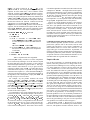
Our static relevance algorithm is designed to detect these
kinds of irrelevance, and as we explain below it can be
used to simplify a planning problem and to provide forward
chaining with a degree of goal direction. The algorithm for
computing the set of statically relevant actions and literals
for a specific planning problem is given in Table 1. The algorithm takes as input a fully ground set of actions. This
set can be computed from a set of parameterized operators
by instantiating the operators in all possible ways with the
constants contained in the initial state 1 .4 First the algorithm performs a forward pass to detect the set of potentially
reachable literals and actions. A literal is reachable if it is
present in the initial state or if it is the effect of some reachable action. An action is reachable if all of the literals in
its preconditions are reachable. Note that marking a literal
or an action as reachable does not mean that it is actually
reachable from the initial state. In particular, an action may
have all of its preconditions marked as being reachable, but
the conjunction of these preconditions might in fact not be
reachable. The loop in steps 2–4 computes the reachable
sets, 90LJ0>(?A and 90L78, .
Then the algorithm performs a backwards pass to detect
the set of potentially relevant literals and actions. A literal
is relevant if it is reachable and it appears in the goal or in
the precondition of a relevant action. An action is relevant if
it is reachable and it produces a relevant literal. The loop in
step 6–8 computes the relevant sets, 9Q;O<>(? and 9:;=<%78, .
4
We have given the algorithm in terms of ground actions, but
our implementation in fact works directly with the parameterized
operators. It generates the ground actions only on an as needed
basis.