1
2520
Pulsed Laser Diode Test System
ESD Protection
A laser diode’s material make-up, design, and small size make it extremely
sensitive to temperature increases and electrostatic discharges (ESDs). To
prevent damage, prior to the start of the test and after test completion, the
Model 2520 shorts the DUT to prevent transients from destroying the device.
The instrument’s 500 nanosecond pulse and measure test cycle minimizes
device heating during test, especially when a short duty cycle is used.
Test Sequencing and Optimization
Up to five user-definable test setups can be stored in the Model 2520 for easy
recall. The Model 2520’s built-in Buffer Memory and Trigger Link interface
can reduce or even eliminate time-consuming GPIB traffic during a test
sequence. The Buffer Memory can store up to 1000 points of measurement
data during the test sweep. The Trigger Link combines six independent software selectable trigger lines on a single connector for simple, direct control
over all instruments in a system. This interface allows the Model 2520 to
operate autonomously following an input trigger. The Model 2520 can be
programmed to output a trigger to a compatible OSA or wavelength meter
several nanoseconds prior to outputting a programmed drive current value
to initiate spectral measurements.
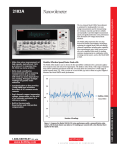
Figure 3. This plot illustrates the Model 2520’s pulsed LIV sweep capability. The sweep was programmed from 0 to 100mA in 1mA steps. Pulse
width was programmed at 1µs at 1% duty cycle, providing for a complete
sweep in just 10ms (excluding data transfer time).
Accessories and Options
The Model 2520 comes with all the interconnecting cables required for the
main instrument and the remote test head. Production test practices vary
widely (automated vs. semi-automated vs. manual), so the cable assemblies
from the remote test head to the DUT can vary significantly. To accommodate these differing requirements, Keithley has developed the Model 2520
RTH to DUT Cable Configuration Guide to help customers determine the
proper cable assemblies to use to connect the remote test head (RTH) to
the DUT.
Figure 4. Model 2520 Remote Test Head
Interface Options
The Model 2520 provides standard IEEE-488 and RS-232 interfaces to
speed and simplify system integration and control. A built-in digital I/O
interface can be used to simplify external handler control and binning
operations.
OPTOELECTRONICS TEST
Additional LIV Test Solutions
For production testing laser diodes after they have been packaged in
temperature controlled modules, Keithley offers the Laser Diode LIV Test
System with increased 28-bit core measurement resolution, allowing for
more detailed characterization. This flexible system combines all the DC
measurement capabilities required to test these modules with tight temperature control over the DUT in a modular instrument package. Configured
from proven Keithley instrumentation, the basic configuration can be easily
modified to add new measurement functions as new testing needs evolve.
1.888.KEITHLEY (U.S. only)
w w w.keithley.com
Multi-channel pulsed
Side Text
test of laser diodes
physics of the connections to the device. Keithley’s optoelectronics applications engineers have addressed these issues by studying and documenting
the optimum cable configuration to enhance measurement accuracy with
extremely fast pulses. Figure 3 illustrates the results of a typical pulse LIV
sweep test with the Model 2520. In this test, a 100-point pulsed LIV sweep
using a 1µs pulse width, at 1% duty cycle, was completed in just 110ms
(including data transfer time), several orders of magnitude faster than
existing, semi-custom test systems.
A
G R E A T E R
M E A S U R E
O F
C O N F I D E N C E