1
Introduction:
Mouse (Ms) interferon-gamma (IFN-γ), a cytokine, is one of the most important members of the interferon (IFN) family.
It is a polypeptide of 155 amino acids having a molecular weight of 17.709 kDa. Mouse IFN-γ is the sole type II IFN,
structurally unrelated to type I IFNs, and binds to different receptors and is encoded by a separate chromosomal locus
(Schroder K et al., 2004). IFN-γ is primarily secreted by activated T cells and natural killer cells and can promote
macrophage activation, mediate anti-viral and anti-bacterial immunity, enhance antigen presentation, orchestrate
activation of the innate immune system, coordinate lymphocyte-endothelium interaction, regulate Th1/Th2 balance,
and control cellular proliferation and apoptosis (Gattoni et al, 2006). Cytokines, most notably IL-12 and IL-18, control the
production of IFN-γ during the course of the immune response. IFN-γ acts mainly through a receptor mediated signaling
process (by IFNGR1/IFNGR2) and signals through the JAK-STAT pathway (Schroder K et al, 2004).
Siloam Biosciences’ OptiMax™ Mouse Interferon-gamma ELISA Kit offers a rapid and sensitive chemifluorescent-based
ELISA procedure for Ms IFN-γ that requires exceedingly small sample volumes. The speed, sensitivity, and small sample
requirements are enabled by the unique microfluidic design of the Optimiser™ plate. The standard immunoassay
reactions such as analyte capture and detection occur within a ~ 5 µL microfluidic reaction chamber. The unique
microchannel geometry and small reaction volume favor rapid reaction kinetics. The Ms IFN-γ procedure utilizes a 5 µL
sample and each reaction step is completed in 10 - 20 minutes. With wash time, substrate incubation time, and read
time accounted for, a typical assay can be completed within approximately 2 hours.
This OptiMax™ ELISA kit has been calibrated against the R&D Systems Quantikine® Mouse IFN-gamma ELISA kit. Data
generated using the OptiMax™ Mouse IFN-γ kit should closely correlate with that generated using the R&D Systems
Quantikine® Mouse IFN-gamma ELISA kit.
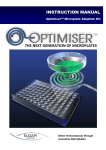
Figure 1. Optimiser™ microplate
The Optimiser™ microplate is a revolutionary new microplate
format. With an ANSI/SBS compliant 96-well layout, the
Optimiser™ integrates the Power of Microfluidics to allow for
low volume, rapid, and sensitive immunoassay protocols. Figure
1 shows the Optimiser™ microplate schematic with magnified
view of one “cell” of the Optimiser™. Each cell of the
Optimiser™ has a loading well (only used to add reagents) and a
microfluidic reaction chamber. Reagents/samples are added to
the well and transported via capillary action to an absorbent
pad (not shown). The unique design of the Optimiser™ allows
the well to be drained but each liquid is trapped in the
microchannel by capillary forces. As the next liquid volume is
added, the capillary barrier is broken and the liquid within the
microchannel is drawn out by the absorbent pad and replaced
by the new reagent. All assay reactions occur within the
microfluidic reaction chamber.
Page 3 of 21