1
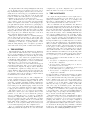
variability of the Journalling Flash File System—one of the numerous files systems supported in both Linux and eCos. The
boxes represent features. The hierarchy represents dependencies; for instance, the Default Compression feature allows
a further choice of sub-features that refine it: None, Priority, or Size. Filled dots mark mandatory features (like Debug Level), which must be selected if the parent is. Hollow dots represent optional features, which do not have this
constraint. Further, several features can be related by a
group constraint: the sub-features of Default Compression are
connected by an arc denoting the xor group constraint—
exactly one of the three choices has to be selected. Finally,
textual cross-tree constraints are listed to the right.
Our goal is (1) to provide quantitative and qualitative empirical evidence whether the concepts researched in feature
modeling are used in real-world modeling languages and
product lines and, if so, how they are used; (2) to widen the
understanding of the design space for the studied concepts.
We analyzed the two languages and the models expressed
in them, the Linux kernel model and the eCos model. We
have instrumented the native tools supporting the languages
to build an infrastructure for collecting quantitative data
about the models. Guided by the collected statistics, we
inspected large parts of the models to study actual usage
patterns. In order to also compare the languages directly (as
opposed to via models) we also compared their semantics.
Many semantic differences turned out to be subtle and not
immediately obvious from the syntax.
With respect to the first objective, our study shows that
the core concepts of FODA feature modeling are supported
by both Kconfig and CDL and are used in both the Linux
and the eCos models. These include Boolean (optional),
integer and string features, a hierarchy, group constraints,
and cross-tree constraints. Interestingly, both languages and
models use concepts that are beyond FODA and have not
been as widely studied as the core concepts:
• Visibility: Both languages allow controlling the visibility of features in the user interface (UI) of the configuration tool via visibility conditions.
• Computed defaults: They both support computing default values of features, using values of other features.
• Binding modes: Kconfig uses three-valued logics to
specify whether a feature implementation is linked statically, built for dynamic linking, or absent. FODA uses
much more space, if representing this in Boolean logic.
• Domain-specific vocabulary: Both languages provide
specialized vocabularies for various kinds of features,
including architectural terms (CDL), such as components and interfaces, or terms related to the configurator UI (Kconfig), such as menus. The vocabularies are
specific to the two projects and likely improve the understandability of the models within the communities.
For the second objective, the study reveals interesting differences in how Kconfig and CDL provide the above concepts:
• Feature representation: Kconfig treats each feature as
a variable, either of Boolean, integer or String type;
CDL, in addition, also supports composite features
that contain both a Boolean component encoding feature presence and a numeric or string value.
• Feature hierarchy: For both languages the hierarchy
shown to users in a configurator largely follows the syntactic nesting in the corresponding model; still, both
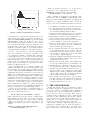
Figure 2: The eCos Configtool GUI
languages offer some mechanisms to control the configuration hierarchy separately from syntactic nesting.
• Group constraints: Kconfig supports feature grouping
constructs with group cardinalities limited to xor, mutex, and or. CDL is more flexible, allowing integer
intervals as group cardinalities; however, the studied
models only use xor, mutex, and or cardinalities.
In feature modeling (and Kconfig), only parents can
impose group constraints on their children; in CDL
features can impose group constraints on any other
features and eCos makes use of it.
• Visibility and computed defaults: Both languages support two types of conditions on a feature: conditions
defining only configuration dependencies and conditions defining both such dependencies and visibility.
Further, visibility and computed defaults are used together to provide derived features—automatically computed features, not shown to the user in the UI. Derived features are used to simplify constraints or define
implementation features used in the build system.
• Constraint language: Both languages support arbitrary Boolean constraints. Kconfig supports also equality tests on integer and string values. CDL adds various arithmetic and string operations, and a few built-in
functions. The models reveal that arithmetic operations are likely needed for embedded software, as in
eCos; whereas string operations could be dealt with in
the build system outside of the models, as in Linux.
We observed limitations in the configurators for Kconfig and
CDL (see Fig. 2 for the UI of the eCos tool). Particularly
the Kconfig configurator lacks reasoning procedures to support choice propagation. To mitigate this, the Kconfig language includes an imperative construct for specifying choice
propagation, which delegates this task to model developers;
however, both the Kconfig user manual and many developer comments in the Linux revision history [11] acknowledge that using the construct is very error-prone. The eCos
configurator is far more intelligent thanks to an inference
engine; however, the engine offers incomplete reasoning and
may propose configuration choices that would not be desirable for the user. Interestingly, both configurators follow a
reconfiguration paradigm: any configuration task starts with
an initial, possibly default, configuration. However, scalable
reasoning to support conflict resolution in reconfiguration
for rich languages such as Kconfig and CDL remains an interesting open problem.