1
t e c h n i c a l
s o l u t i o n s
Cutting
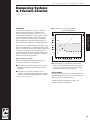
n On CFB, unwanted background color will develop on
the CF side under the clamp (hold-down bar) if pressure
is excessive.
n After CFB has been cut without unwanted color
formation, CB can be cut using the same pressure and
procedure without damage to the dye capsules.
n CF grades are not pressure-sensitive and may be
trimmed using the same procedure as for bond paper.
Cutting carbonless paper to prevent damage:
n Reduce the clamp pressure to less than 35 p.s.i. (total
clamp gauge pressure divided by square inch surface
area of the clamped paper). This will not cause color
development on CFB and will not damage CB coating.
n Place a piece of open-cell, medium-density sponge
rubber, 3/8 ”to 3/4 ” thick, under the clamp to cushion the
impact of the clamp. With some large guillotine cutters,
it is advisable to prevent the clamp from striking the
paper. Apply clamp pressure gradually.
n If there is no coloration on the CFB immediately after it
is cut, the final developed color, if any, should be slight
and unobjectionable.
The cut edge on CFB will show a small amount of
coloration. This can be minimized by:
n Using a sharp cutter knife and
n Preventing “draw”, i.e., movement of the paper,
under the clamp.
Experience has proven that the reduced clamp pressure
required to cut carbonless paper is still sufficient to
prevent “draw”, which can affect sheet dimension
and give undesirable edge coloration.
CUTTING & GLUING
Exercise caution when guillotine-cutting pressure-sensitive
grades of NCR PAPER brand.
If the printed, live area of a job is positioned on an
oversized sheet, it may be possible to clamp on the part
of the sheet to be discarded, eliminating any possibility
of damage to the printed area.
n Block up the clamp with a chipboard stack. The stack
should be 1/4” higher than the lift of paper and 1/2 ”
from the edge of the paper. Chipboard may be placed
on top of the forms to be cut and will reduce the
pressure damage on the lift of forms and eliminate
any draw.
n Be sure the shear stick, which receives the knife, is
even with the table and in good condition. Place a
protective sheet of chipboard under the lift to prevent
marking of the bottom sheets in a lift.
n “Gang” cutting (more than one lift of forms cut at the
same time) can be a convenient way to distribute
clamp pressure, and prevent capsule damage.
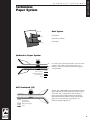
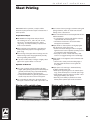
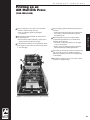
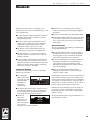
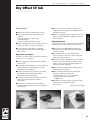
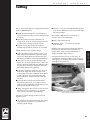
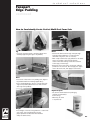
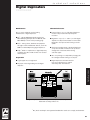
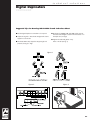
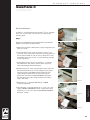
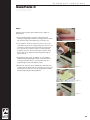
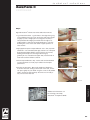
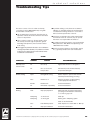
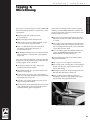
Sponge rubber pad is attached to bottom of the clamp bar.
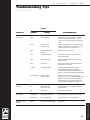
Chipboard stack prevents clamp damage to lift of paper.
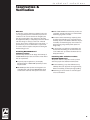
Proper trimming methods provide best results.
If there is any capsular damage, it will become more
apparent in time.
n The initial lift should be observed shortly after cutting
to see if there is any indication of unwanted color
indicating capsule damage.
25.