1
In order to avoid this, Grph provides a built-in mechanism which stores
the results of calculations until a change occur in the structure of the graph.
Changes include vertex or edge removal or addition. By default, property
changes on vertices or edges are not taken into account (because Grph has
no mean of detecting them).
Consequently, between two changes of the graph structure (it is also likely
that the graph is static, e.g. is will never change), the first invocation of a given
graph operation will be performed in the theoretical time complexity, while
each subsequent one will be performed in constant time — it actually won’t be
performed at all, since the cache will bypass it.
When a change occurs (event the slightest one), the entire cache is cleared.
If you want you algorithm to take benefit of the caching mechanism, you
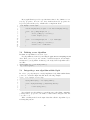
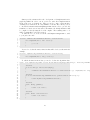
simply need to wrap it into a CachingGraphAlgorithm object. The following
code does it for you:
1
2
3
4
5
6
7
8
9
c l a s s MyGrph e x t e n d s Grph
{
p r i v a t e MyAlgo myAlgo = new MyAlgo ( ) . c a c h e ( t h i s ) ;
p u b l i c i n t getMyValue ( )
{
r e t u r n myAlgo . compute ( t h i s ) ;
}
}
By doing this, the result provided by your algorithm will be cached until a
topological change occur in the graph. The benefit of the caching mechanism
is higher when the graph is little dynamic and when computations and timeconsuming.
5.6.2
On-demand processing
Processing is done only when the result is requested. This avoids useless processing.
5.6.3
Using native code
Most critical algorithms are implemented in C and compiled to the target machine. These algorithms are called native algorithms. Like all algorithms in
Grph, a native algorithm comes in the form of a Java class. A native algorithm
additionally come with a C file. When the algorithm is first executed, Grph
compiles the C source by using optimizations for the local machine. To do this,
the gcc compiler must be available on the corresponding computer. If the C
code cannot be compiled, an optional alternative 100% pure Java algorithm is
executed.
Many people complain about the poor performance of Java implementations.
Our experiments show that C implementations are about 5 times faster than
equivalent Java ones.
12