1
...the world's most energy friendly microcontrollers
1 EFM32 Power Consumption Model
This application note includes several electrical characteristics for the EFM32 devices. These numbers
are included as a typical reference only and could contain errors or not be applicable to all EFM32
devices. It is therefore best to always check the datasheet for the device at hand for precise numbers.
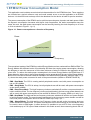
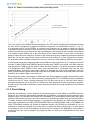
The power consumption of the EFM32 can be split into two main parts, dynamic and static power. While
the dynamic consumption increases with higher clock frequencies, the static consumption stays the
same. As such, the static power consumption can be found by lowering the clock frequency to or close
to 0 Hz as shown in Figure 1.1 (p. 2)
Figure 1.1. Power consumption as a function of frequency
Power
Dynam ic power
Static power
Frequency
The operational modes of the EFM32 are called Energy Modes and are numbered from EM0 to EM4. The
Energy Modes offer different levels of functionality and thus also varying power consumption, allowing
the designer to scale the resources to fit the bare minimum of what is needed in the application at any
given time. To reduce the static power consumption in the lower Energy Modes, the EFM32 has of 3
power domains, where one or two of these domains can be powered down in some of the Energy Modes.
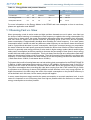
Below is an overview of the main features available in the different Energy Modes, whereas Table 1.1 (p.
3) shows the static power consumed in each of the power domains (based on EFM32TG840F32).
• EM0 - Run Mode: The CPU is running and all peripherals can be used, with power consumption as
low as 150 µA/MHz.
• EM1 - Sleep Mode: The CPU is asleep, but all peripherals can still be used, with power consumption
as low as 45 µA/MHz.
• EM2 - Deep Sleep Mode: The high frequency clocks are switched off and the core power domain is
held in retention mode. The low frequency clocks and peripherals in the low energy power domain can
still be used, with power consumption as low as 900 nA with an RTC running. Wake-up in only 2 µs.
• EM3 - Stop Mode: The high and the low frequency clocks are switched off and the core power domain
is held in retention mode. The asynchronous peripherals in the low energy power domain can still be
used, with power consumption as low as 590 nA. Wake-up in only 2 µs.
• EM4 - Shutoff Mode: The high and the low Frequency clocks as well as the low energy and core
power domains are switched off. The power consumption can be as low as 20 nA, but the device must
be reset to return to EM0 again. In some devices it is possible to run an RTC from a low frequency
clock and keep up to 512 bytes of data retained in this mode as well, then consuming about 400 nA.
2013-09-16 - an0027_Rev1.02
2
www.silabs.com